Economy and Society

AI in Education: How India’s Students Are Studying and What Policy Has Missed

Abstract The rapid integration of Artificial Intelligence (AI) and Large Language Models (LLMs) into India’s educational landscape is significantly ahead of the development of corresponding policy and governance frameworks. This paper provides findings from an original primary survey of 125 students across three age groups (below 12, 13–19, and 20 and above) in Bangalore, India, […]

Demystifying Petrol Prices in India (2017–2026): Taxation, Price Transmission, and State-Level Divergence

Introduction  To categorise petrol as being just another commodity, would understate its significance. Long before it became a household expense, it served as an instrument of industrial expansion, military strategy, and statecraft. From the oil shocks of the 1970s to the Gulf Wars and more recently, the disruptions following the Russia–Ukraine and West Asia conflicts, […]

Victims of Platform Capitalism: Psychological Harm, Algorithmic Control, and Gig Work in India

Introduction Gig work is often presented as a hallmark of “platform capitalism,” where technology firms organise labour into on-demand tasks through smartphone applications (Saxena, 2026). India has over 7.7 million gig workers and this number is expected to grow fourfolds by 2029–30, with the sector potentially contributing 1.2% to the country’s GDP. According to the […]

Counting the Invisible: Why India Needs a Migration-Aware Labour Database

During the second wave of COVID-19, tens of thousands of migrant workers were abandoned and left to their own devices. Through empty bus depots and highways, many attempted to reach their home state on foot. The workers were from Bihar and Jharkhand who had left their homes and travelled to Surat, Delhi, and Ahmedabad in […]

From SHGs to Entrepreneurs: The Missing Link of Mentorship for Rural Reform 

Out of every ₹100 India spends, less than ₹4 goes to rural development. Of that, barely 40 paise supports rural women’s skill based livelihoods, where nationally 100 women depend on a single trainer to learn the skills meant to transform their incomes. From early morning chores to long hours in the fields, rural women across […]

Challenges with the Implementation of the National Education Policy 2020

Introduction The National Education Policy 2020 was introduced about six years ago, replacing the 1986 policy, and is now past the nascent stage of preparation. NEP 2020 emphasized a big shift in early childhood education, introduced a new school structure, and intended to make learning multidisciplinary and flexible.  As the policy moves out of its […]

The VB G RAM G Bill and the Future of Rural Employment Governance in India

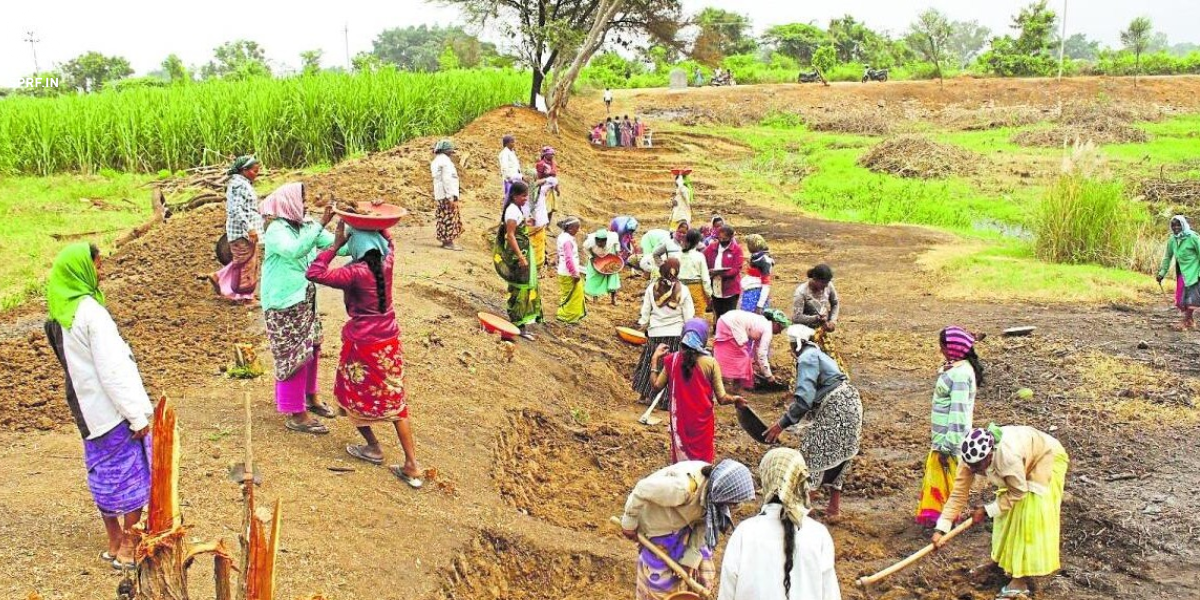
Introduction The Indian state’s role and responsibility in ensuring rural workers’ livelihoods have been revived with the introduction of the VB G RAM G Bill, which was prompted by the issue of the MNREGA program facing rollout gaps, wage non-paying delays, pressure typified by actual allocation levels, as well as requests for increased administrative oversight over […]

From Make in India to Create in India: Charting India’s ‘Orange’ Economy Frontier

During India’s first World Audio Visual and Entertainment Summit (WAVES) 2025 in Mumbai, Prime Minister Narendra Modi announced the dawn of the ‘Orange Economy.’ He highlighted how creators—from Guwahati musicians and Kochi podcasters to Bengaluru game designers and Punjabi filmmakers—are powering India’s march towards a $5 trillion economy. The orange economy, also known as the […]

Shram Shakti Niti, 2025 and the End of Political Unionism in India?

1. Introduction Public Policy, most laconically, is defined as “whatever governments choose to do or not to do”  (Chakravarty & Sanyal, 2017, p. 4). The recently released draft national labour and employment policy, the Shram Shakti Niti, makes for an interesting case study on why “not doing something” is an equally, if not more important […]