Out of every ₹100 India spends, less than ₹4 goes to rural development. Of that, barely 40 paise supports rural women’s skill based livelihoods, where nationally 100 women depend on a single trainer to learn the skills meant to transform their incomes.
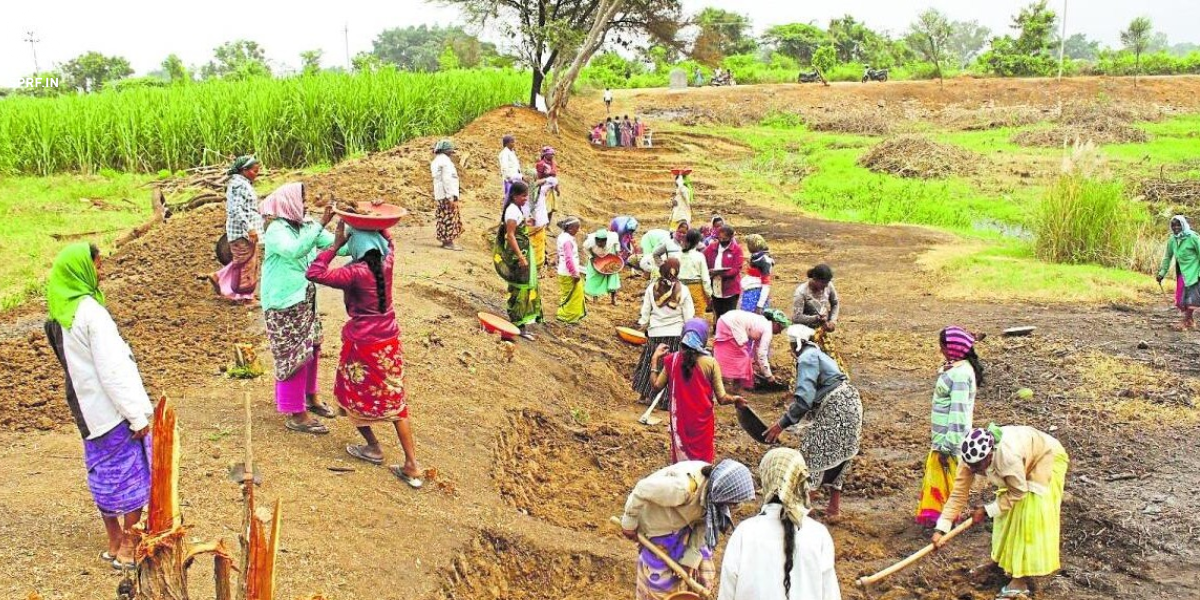
From early morning chores to long hours in the fields, rural women across India carry the weight of both households and livelihoods. In between, she is a farmer, a caregiver, and by the evening, many of them gather in Self-Help Group (SHG) meetings, where they aspire to become independent.
Over the past five decades, India has built one of the world’s largest women-led grassroots networks through its Self-Help Group (SHG) movement. Today, more than 93 lakh SHGs connect more than 10 crore rural women, enabling access to savings, credit, and collective decision-making, an achievement of remarkable scale (Lakhpati Didi Insight Hub, 2026).
But scale is not the same as transformation.
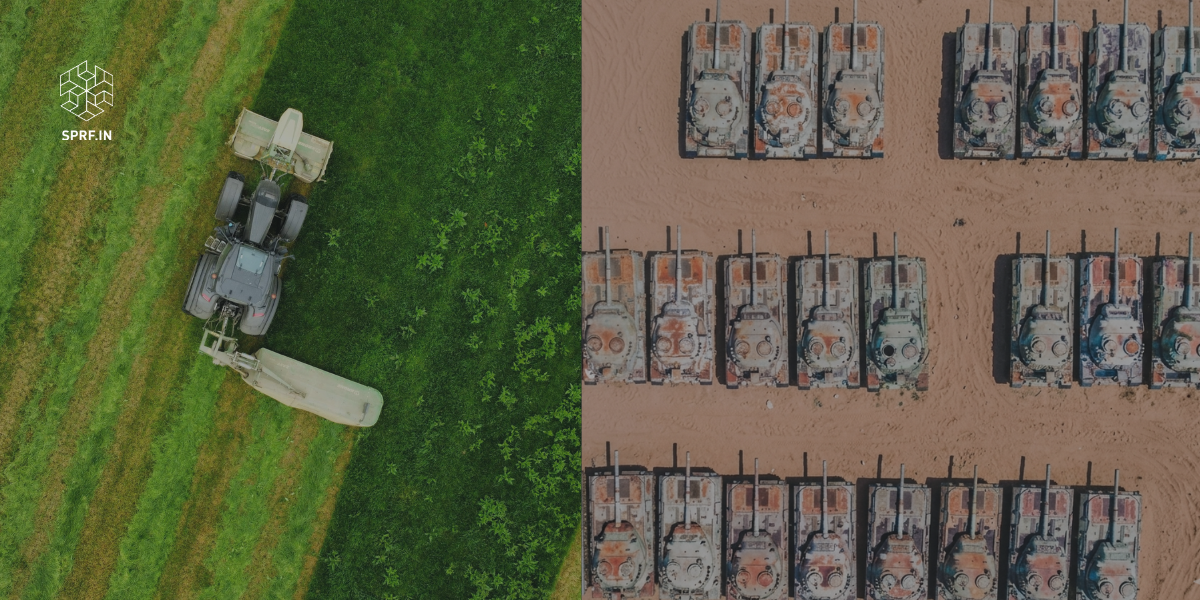
This year’s Union budget once again underscored this imbalance. Of every ₹ 100 spent, less than ₹ 4 goes to rural development. Within that, only a fraction supports skill-based livelihoods and enterprise-building. While capital expenditure and infrastructure development projects continue to have a larger share.
At the same time, the government has set up an ambitious vision towards reforming SHGs. Under the Lakhpati Didi initiative, over 3 crore women have already crossed a minimum annual income of ₹1 Lakh per annum, with millions identified as potential beneficiaries (Lakhpati Didi Impact, 2025). The next step is even more significant: transitioning SHG members into entrepreneurs through SHE marts (Self Help Entrepreneur Marts), a community-owned retail space, managed by SHGs and their federations.
Data from the Ministry of Rural Development reveal that West Bengal has 11.87 Lakh SHGs, the highest number in the country, while Andhra Pradesh, has the highest average SHGs per village (Lakhpati Didi Insight Hub, 2026). While these numbers indicate aspiration, achievement, hope and India’s success in mobilizing beneficiaries, yet there lies a missing link.
And it is, Mentorship.
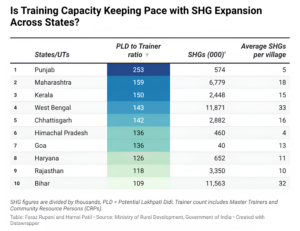
India’s large-scale mobilization efforts on trainers fall far behind. Nationally, there are about 100 potential Lakhpati Didis for every trainer. This ratio exceeds the manageable and acceptable limits of 50-75 beneficiaries per trainer as per government standards (Ministry of Rural Development, 2024). In states like Punjab, a single trainer is expected to support over 250 women, and only 13 states/UTs having an acceptable ratio with the majority of them being smaller states/UTs (Lakhpati Didi Impact, 2025).
This is not a marginal inefficiency but a systematic constraint.
The proposed SHE mart initiatives would not only need access to credit and local infrastructure, but needs an entire ecosystem to be built from scratch. Retailing requires capabilities in inventory management, customer engagement, and financial planning, along with sustained support for branding and demand generation. Women-led enterprises would also require customised handholding, flexible working capital beyond microcredit, transparent governance, and reliable supply chains to establish a supportive ecosystem.
While such skills and resources may be familiar to urban entrepreneurs, in rural contexts, the idea warrants objective reassessment, particularly when the supply of trainers, on whom the entire system depends, is already limited.
Nearly 55 years into the SHG journey, India has mastered mobilisation but not mentorship, and this is a striking irony. This mismatch is not just about numbers, it’s about design where transformation is planned without upgrading its support structure.
There are still clear pathways that need to be re-designed to make SHE mart a success.
First, mentorship needs more supporting hands. The idea of Self-Help Entrepreneur (SHE) initiatives is necessary and promising, yet poor trainer ratio raises concerns about the rollout, especially when existing programmes are already constrained by limited resources.
Second, strengthening training and capacity by enabling experienced Lakhpati Didis to mentor new entrants could potentially ease out the burden on master trainers while strengthening peer-led learning in foundational skills.
Third, India’s e-commerce market is projected to grow by over 5 times by 2034 (IMARC, 2025), and scaling SHE marts through a dedicated digital portal could be a potential game changer. Strong digital literacy, and market intelligence training would be essential to help rural entrepreneurs compete with well-capitalised, technology-driven players.
Finally, policy must recognise that entrepreneurship cannot be mass produced through targets alone. It requires long term investment in people while also supporting regular investments in programmes.
India has built scale, but now needs to build its depth. Without mentors, markets alone will not transform livelihoods even if investments in programmes are doubled. Missing this transformative opportunity could lead to reversing the momentum that SHGs have painstakingly built over the past half century and SHE Marts could risk becoming merely a “place to sell” rather than a pathway to stable income.