Introduction
The Indian state’s role and responsibility in ensuring rural workers’ livelihoods have been revived with the introduction of the VB G RAM G Bill, which was prompted by the issue of the MNREGA program facing rollout gaps, wage non-paying delays, pressure typified by actual allocation levels, as well as requests for increased administrative oversight over the MNREGA. The government is projecting the government’s Perspective VB G RAM G as an effort to reform rural employment delivery and bring it in closer conformity with development imperatives, specifically in areas like asset creation, water conservation and infrastructure. Critics, however, express concern that the Bill may dilute the rights-based character of MNREGA.
The question, therefore, is not merely one of programme design but of how the state mediates between water-tight efficiency and development on the one hand, and employment security on the other. It is in this context that the current issue brief considers the proposed Bill, the mandate of MNREGA and the economic work it has done for rural India till now, as well as the VB G RAMGINI controversy in the context of legislative and civil society discourse. What this article argues This article has argued that, although VB G RAM G may facilitate administrative coordination and development, it does nonetheless present us with challenging questions regarding the implications of employment protection being threatened by the legal entitlement status of the latter, yielding to an administratively mediated benefit.
Policy Objectives and Design: From Legal Entitlement to Programmatic Welfare
MNREGA, passed in 2005, was globally unique because it legally guaranteed up to 100 days of wage employment on demand, with unemployment allowance if work could not be provided within a specified time. Its big contribution, it has been argued by scholars, was not simply the amount of employment that it created but in making employment support legally justiciable. Jean Drèze has pointed out that MNREGA meant a “right to work” and transformed the relationship between rural residents and the government by converting labour support from a discretionary one into an obligation, see his writings in the Indian Journal of Human Development and in his public commentary for The Hindu.
The VB G RAM G Bill, in comparison, seems to have more focus on planned development outcomes along with employment generation. Draft versions and worked examples released to the public suggest that the job creation would be based upon predetermined funding envelopes, centrally determined work packages and improved digital surveillance. Analysts working on policy wrote about the Bill in Forbes India towards the end of 2025, observing that it has shifted emphasis to project outcome policies themselves: for example, goals such as rural infrastructure or water conservation and not just employment scheme-disbursal, with work availability shaped more by administrative planning.
This shift in design has implications for governance too. Under MNREGA, the gram panchayat was conceived as an important implementing authority in which Gram Sabhas would be involved in work selection and social audits. Anish Vanaik and Siddhartha have argued in the Economic & Political Weekly that partial decentralisation has already led certain areas to become less corrupt and more democratically accountable. A norm-based framework under VB G RAM G (more centralised) may provide more systematic and effective standardisation of campaigns and oversight. However, it also calls into question whether local participatory mechanisms will continue to have a significant enough impact on the processes of accountability and work selection. The structural differences between the two frameworks are summarised in Table 1 below.
Table 1
MNREGA and VB G RAM G Bill: Comparative Features
| Dimension | MNREGA | VB G RAM G Bill (Proposed) |
| Legal Foundation | Statutory right under the Mahatma Gandhi National Rural Employment Guarantee Act guaranteeing up to 100 days of wage employment per rural household. | Proposed statutory framework; employment provision appears program-driven rather than strictly demand-guaranteed. |
| Nature of Entitlement | Demand-driven; work must be provided within a stipulated period or unemployment allowance is payable. | Employment tied to pre-approved projects and defined budget envelopes; entitlement mediated through administrative planning. |
| Primary Objective | Livelihood security and income stabilisation for rural households. | Integration of employment with development goals such as infrastructure, water conservation, and durable asset creation. |
| Governance Structure | Decentralised planning through Gram Sabhas; social audits and local accountability mechanisms embedded in design. | Greater central coordination, standardised work packages, and enhanced digital monitoring. |
| Fiscal Design | Open-ended demand within allocated funds; Centre–State cost sharing. | Likely capped or program-bound allocations linked to project planning. |
| Crisis Response Capacity | Demonstrated counter-cyclical role (e.g., surge during COVID-19). | Scale-up flexibility may be limited if employment depends on pre-planned works. |
| Normative Framework | Rights-based welfare model (employment as a justiciable entitlement). | Development-oriented welfare model (employment as part of structured programmatic delivery). |
MNREGA as an Economic Support System and the Risks of Replacement
The MNREGA and its effect on rural labour markets have been studied extensively. An influential study by Clément Imbert and John Papp, written for the London School of Economics, noted that MNREGA led to increases in rural casual wages and decreased short-term distress migration, particularly among unskilled laborers. They found, for example, that MNREGA acted as a wage floor resulting in private employers’ being influenced to alter their labor practices.
MNREGA served as a safety net at the household level. Among landless households, MNREGA participation has been found to be negatively associated with food insecurity and seasonal migration, as well as positively associated with consumption smoothing on a longitudinal study in Rajasthan by Mrutyunjay Swain of the Indian Society of Agricultural Economics. Female workers in particular gained from paid employment available locally, as such work mitigated reliance on more vulnerable forms of labour.
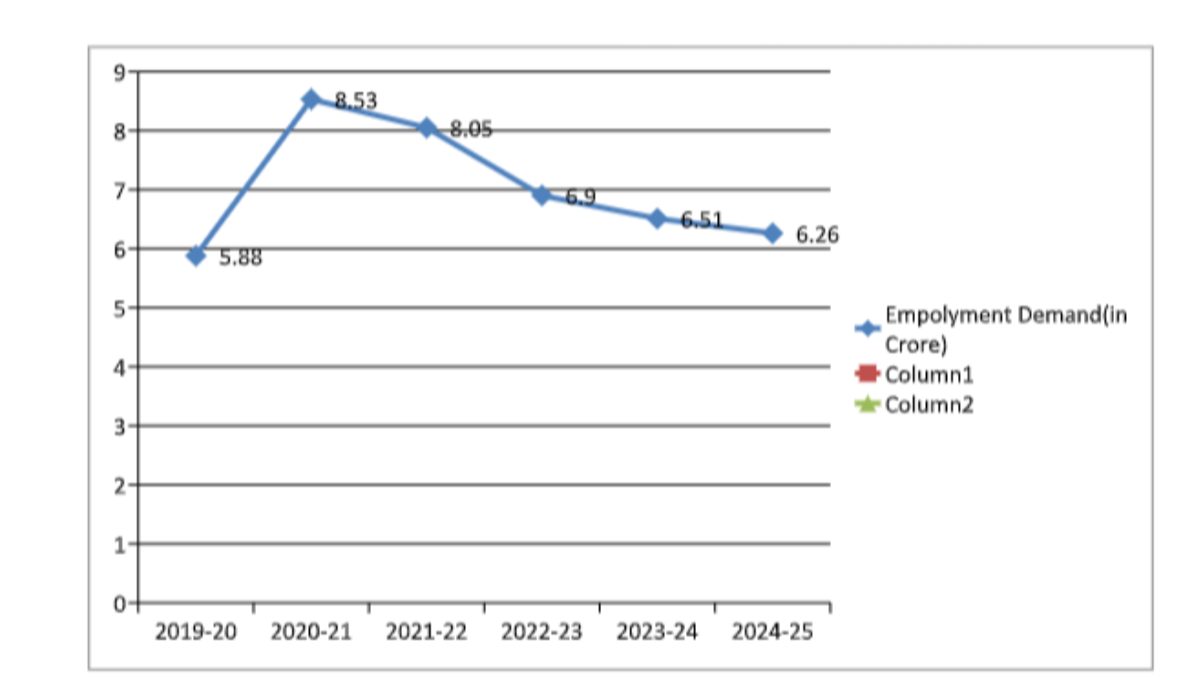
These stabilisation effects were particularly clear during times of trouble. During the COVID-19 pandemic as city job markets shrunk MNREGA took in a number of migrant workers who came back home. The Centre for Monitoring Indian Economy and economists writing in The Indian Express said that MNREGA played a role in helping during hard times. They noted that MNREGA jobs peaked when private jobs decreased. As shown in Figure 1 (The Indian Express) people asking for work went down from its peak of 8.53 crore household requests in 2020-21 to around 6.26 crore in 2024-25. This shows that some workers went back to city jobs and other opportunities of just staying in rural areas due, to trouble. MNREGA helped people during the COVID-19 pandemic and its effects are still seen today. The scheme gave workers a way to earn a living when they needed it most.
Figure 1
Decline in Demand for Employment under MNREGA in the Post-COVID Period (2019–20 to 2024–25)
Consequently, the proposal to shift from MNREGA to VB G RAM G would raise the question of whether a new framework can retain this counter-cyclical potential. Whilst a development-oriented model could enhance asset creation and longer-term productivity, the lack of an explicit demand-driven guarantee could constrain the ability of the scheme to facilitate rapid adjustment to future shocks. Non-legally binding welfare instruments might be constrained when the scale is up exactly, while economic conditions worsen.
The Debate Around the VB G RAM G Bill
Different priorities are reflected in the debate surrounding the VB G RAM G Bill rather than a single, cohesive criticism. In the Parliament, issues have been on governance, federalism and implementation practicality. Summary by PRS Legislative Research records concerns around the budgeted ceiling, extent of decentralisation and how states and gram panchayats will impact work planning under the new scheme.
Responses from civil society have mostly concentrated on the reform’s normative ramifications. According to Jean Drèze’s argument in The Indian Express, the Bill signifies a move away from employment as a legal right and toward a form of support that is more administratively managed. Many of MNREGA’s operational issues are due to implementation limitations and funding adequacy rather than the rights-based design itself, according to campaign networks like the NREGA Sangharsh Morcha, whose statements are archived by the Right to Food Campaign.
Collectively, these viewpoints imply that the discussion should centre on how reforms can strike a balance between rights-based guarantees, developmental goals, and administrative efficiency rather than whether rural employment policy should change.
Conclusion
Rather than being a purely technical policy change, the VB G RAM G Bill represents a substantial reconfiguration of rural employment governance. It shows an attempt to combine digital governance reforms, development planning, and employment provision. MNREGA’s rights-based design significantly contributed to the stabilisation of rural livelihoods, as evidenced by its effects on wages, migration outcomes, and crisis response. Therefore, any departure from MNREGA necessitates a thorough assessment of its effectiveness and developmental results, as well as its preservation of the fundamental tenet of job security as a public duty. The protective role of MNREGA may be preserved while some of its administrative restrictions are addressed by a revised framework that incorporates developmental planning with protections for demand-driven employment.
The VB G RAM G framework could maintain a small demand-responsive component during times of economic hardship in order to strike a balance between livelihood protection and developmental goals. This would enable the program to act as a safety net when rural labour markets deteriorate. The protective logic of MNREGA would be maintained while administrative flexibility would be permitted by introducing conditional legal safeguards that are triggered by indicators like crop failure or local unemployment.

 Tanvi is a criminologist with a BA in Psychology (Hons) from Delhi University and an MA in Criminology, specialising in Forensic Psychology from National Forensic Sciences University, MHA. She has worked on research and policy-focused projects during her internships with the National Commission for Women and the Ministry of Information and Broadcasting, exploring issues at the intersection of gender, crime, and justice. Beyond her academic and professional work, Tanvi is a trained musician, holding a Prabhakar degree in Music, and a passionate cinephile with a love for storytelling in all its forms. She finds inspiration in films, music, and art, using each as a way to explore and better understand people and the world around her.