
Introduction
Gig work is often presented as a hallmark of “platform capitalism,” where technology firms organise labour into on-demand tasks through smartphone applications (Saxena, 2026). India has over 7.7 million gig workers and this number is expected to grow fourfolds by 2029–30, with the sector potentially contributing 1.2% to the country’s GDP. According to the International Labour Organisation (ILO), India has 20 per cent of the global platform workforce and is one of the world’s largest markets for platform labour (NITI Aayog, 2022; Peerzada Abrar, 2024).
The expansion of gig work has been driven by rapid urbanisation, increasing smartphone penetration, and growing demand for app-based services. Delivery workers employed by these are commonly described as “partners” and are marketed to have flexibility and autonomy. While transport and food delivery remain dominant sectors, platform work is increasingly expanding into retail, logistics, finance, manufacturing, and household services.
The demographic profile of gig workers also reflects broader labour market shifts. Youth participation has increased substantially in recent years, with many platforms becoming sources of first employment for young workers. Women engagement has shown an uptick and is expected to further grow in the coming years. These trends suggest that the gig economy is no longer a marginal labour arrangement but an increasingly significant component of India’s workforce.
Although the gig sector is seeing growth, research on platform labour in India suggests a different story. A 25-month ethnographic fieldwork in Hyderabad, found that food delivery platforms regulate workers through geo-fencing, performance monitoring, and continuous digital surveillance, exercising forms of control that resemble employer authority (Hussain., 2025). Similarly, Chakraborty and Heeks (2023) pointed out how ride-hailing drivers navigate opaque systems of algorithmic and human management while remaining dependent on decisions they cannot meaningfully influence.
These tensions between formal independence and practical subordination are central towards understanding both exploitation and the lived experience of gig work. While platforms market themselves as fully flexible and a sense of entrepreneurship, work is increasingly governed by ratings, incentives, opaque algorithms that allocate tasks, determine pay, monitor performance, and facilitate deactivation.
This commentary examines gig delivery work through psychological and criminological perspectives, arguing that instability, surveillance, and constant evaluation generate harms that are structurally embedded within platform design and weak regulatory frameworks.
Psychological Perspective on Gig Work
Platform work is often promoted as offering flexible employment opportunities yet studies have increasingly linked platform-mediated gig work to heightened stress, poorer mental health, and lower life satisfaction compared to standard employment (Wang et al., 2025). Survey evidence also indicates that gig workers report worse mental health than both full-time and part-time employees, with financial insecurity and loneliness accounting for much of this disparity (Wang et al., 2022). Although gig work may improve well-being relative to unemployment, it generally produces poorer outcomes than regular employment due to persistent insecurity and weaker social support networks (Lu et al., 2023).
The defining characteristics of gig work comes with uncertainty from lack of fixed schedules for orders, volatile earnings, long hours without sufficient orders, even sudden drops in demands, and shifting incentive structures that undermine their ability to plan for basic needs (Schneider & Harknett, 2020). Psychologically, such conditions can foster learned helplessness, where effort no longer appears to guarantee reward or stability.
Cognitive overload is also built into platform design. Riders are required to simultaneously manage navigation, traffic risks, delivery instructions, time pressure associated with on-time delivery, security checks, notifications, customer ratings, door-to-door deliveries, and the acceptance of a new order while completing the on-going deliveries. This constant divided attention creates sustained cognitive strain, where even minor mistakes can result in disproportionate penalties through ratings or algorithmic downgrades (Chaudhary, 2026).
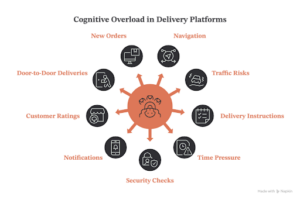
Emotional exhaustion, therefore, is less a matter of individual weakness than a consequence of systemically produced uncertainty and continuous vigilance. It should be understood as consequences of broader structural arrangements rather than individual shortcomings.
Surveillance, Ratings, and Internalised Control
One of the defining features of the gig economy is the invisible nature of control. Ratings, customer feedback, and GPS tracking form a pervasive system of surveillance in gig work. Workers are continuously monitored for location, speed, route choice, and delivery times, with this information feeding into algorithmic systems that shape access to future orders and incentives (Kadolkar et al., 2024). Customer ratings, often influenced by factors beyond workers’ control such as restaurant delays or app malfunctions, does significantly affect their standing on the platform (Rahman & Cameron, 2022).
Over time, constant evaluation leads to internalised discipline. In order to avoid poor ratings or deactivation, workers often take riskier routes, tolerate customer abuse, and suppress complaints about safety (Wang & Churchill, 2024). The promise of autonomy associated with “partner” status frequently clashes with opaque systems of algorithmic control, creating a gap between perceived independence and lived experience (Sivarajan et al., 2021). As a result, workers become both the subjects and instruments of surveillance, monitoring themselves to meet platform expectations.
Research in India similarly shows that algorithms increasingly govern task allocation, work intensity, monitoring, and even workers’ ability to take breaks, while grievance mechanisms often remain ineffective (Sanjay et al., 2025). The absence of accountable human decision-makers can intensify feelings of isolation and powerlessness.
Rather than being directly supervised by managers, workers are governed through ratings, performance metrics, and algorithmic evaluations, creating an appearance of autonomy while limiting genuine decision-making power. This lack of transparency is particularly concerning because systems that shape workers’ livelihoods should provide meaningful opportunities for explanation, appeal, and redress.
Criminological Angle: Structural Harm and State Corporate Arrangements
From a criminological perspective, gig work is best understood through the concept of structural harm rather than conventional crime or isolated labour law violations. Structural harm directs attention away from individual actions to the broader conditions that produce insecurity and risk. Exploitation does not usually take the form of a single illegal act but emerges through contractual arrangements, algorithmic control, and regulatory gaps that systematically shift risks and costs onto workers.
The constant pressure to meet targets, deadlines, ratings and algorithmic management leads to intensive surveillance and automated monitoring without any bargaining power, encouraging risky behaviours. These behaviours are responses to systemic strain rather than a simple deviance as livelihoods depend on meeting algorithmically determined benchmarks, forcing workers to prioritise speed over safety which even leads to occupational accidents (Khan & Velaga, 2024; Pervez et al., 2026; Rani et al., 2022; Hennum Nilsson et al., 2025)
The harms experienced by gig workers should not be viewed as accidental but as outcomes of how platform labour is organised. While governments often celebrate platforms as engines of innovation and employment, regulatory frameworks have been slower to address chronic insecurity, algorithmic opacity, and procedural unfairness, allowing structural harms to persist with limited accountability.
Although many of the harms experienced by workers, uncertainty, algorithmic control, psychological distress, and increased risk, may not fit conventional definitions of crime, they remain significant. It is important to highlight the need for criminology to engage more seriously with harms that are normalised through economic and technological systems.
Gig Workers as Invisible Victims
Victimology has traditionally focused on discrete, legally recognisable harms such as assault, fraud, or accidents. Gig workers, however, often experience a different form of victimisation, one that is gradual, cumulative, and embedded within everyday work. A qualitative study of food delivery riders in urban India found that workers experience persistent physical strain, emotional discipline under surveillance, and chronic exhaustion linked to delivery pressures and traffic conditions (Kariveliparambil et al., 2026).
Rather than a single identifiable incident, gig workers often face ongoing anxiety over deactivation, ratings, customer complaints, and unstable earnings. Research on algorithmic management in India similarly finds that platform systems generate wage volatility, psychological stress, and burnout while shifting risks onto workers through opaque decision-making processes (Marappan, 2026). As a result, harm becomes normalised and is often interpreted as personal stress or financial mismanagement rather than a consequence of platform design.
This makes gig workers largely “invisible victims.” Their suffering is dispersed, continuous, and frequently overlooked in both legal and public discourse. Studies also show that platform workers face occupational stigma despite performing essential services, reinforcing their marginal position within society (Hussain, 2026). Victimology has often struggled to account for harms that emerge through ongoing social and economic processes rather than discrete criminal events.
The rhetoric of “choice” and “flexibility” often obscures victimisation. The experiences of gig workers challenge these conventional distinctions between workers and victims, suggesting a need to expand victimological of harm beyond legally defined incidents.
Current Policy Structures and the Production of Invisibility
India’s regulatory response to the gig economy has focused primarily on questions of classification, social security minima, and partial inclusion of platform workers within new labour codes. Recent reforms, for example, contemplate bringing certain categories of gig and platform workers under the ambit of social security measures, including insurance coverage for those who meet thresholds such as working 90 days a year on a platform (Press Information Bureau, 2025).
While significant, these developments remain heavily oriented around formal coverage, job creation, and wage-related protections, with far less attention to algorithmic opacity, mental health, or the everyday experience of control and uncertainty. By prioritising income protections, policy frameworks often overlook the psychological harms of gig work.
Workers’ protests across Indian cities, including strikes by delivery workers have repeatedly highlighted these issues, linking low pay to wider concerns about opaque algorithms, sudden changes in payout structures, and unsafe working conditions (Negi et al., 2025). Nationwide and regional strikes around the end of 2025 and early 2026, including actions affecting Delhi–NCR, demonstrate that what is at stake is not only wages but dignity, predictability, and recognition as workers deserving of voice and protection (Progressive International, 2025).
Conclusion
Platform work is framed as entrepreneurial freedom and many workers enter the sector because of unemployment, income shocks, or limited alternatives. Labour exploitation in the gig economy operates through subtle yet pervasive mechanisms that differ from those on the factory floor, yet are no less consequential. The psychological and structural harm being caused to the gig workers due to the structure must broaden beyond minimal social security and nominal inclusion in labour codes. Stress, anxiety, cognitive overload, and erosion of dignity are structurally produced yet largely invisible in conventional policy discourse.
Algorithmic opacity cannot be treated as a purely technical matter; it is a core mechanism through which power and uncertainty are produced and must therefore become a central object of regulation. Workers should have enforceable rights to know how ratings are calculated, how pay structures are designed, and on what grounds deactivations occur, including access to timely, human review of automated decisions.
Similarly, predictability needs to be recognised as a labour right. Policies should mandate platforms to provide transparent, advanced notice of changes in incentive schemes, minimum guarantees during high-demand periods, and clearer information about expected earnings ranges under different working patterns. Such measures would not eliminate precarity, but they would mitigate some of the chronic uncertainty that drives stress and undermines mental health.
Mental health support and psychosocial protections should be built into platform governance rather than added as afterthoughts. This might include mandatory rest provisions, limits on consecutive working hours, easily accessible counselling hotlines, and collective spaces, digital or physical, where workers can share experiences and organise.
Gig workers must be recognised as workers with rights, not as a marginal category of “partners” outside the ambit of standard protections. This recognition should extend to the ways in which labour law, social security, and data protection regimes intersect, ensuring that psychological harm generated by algorithmic control and chronic insecurity is treated as a legitimate concern of labour policy, not merely a private mental health issue.
As delivery workers and other platform labourers continue to mobilise in cities across the country not only to challenge wage levels but the very terms on which their work and suffering are recognised. Any serious attempt to regulate the gig economy must have an integrated approach which draws together psychology, policy analysis, and criminology, recognising gig workers as both structurally harmed and symbolically marginalised.

 Tanvi is a criminologist with a BA in Psychology (Hons) from Delhi University and an MA in Criminology, specialising in Forensic Psychology from National Forensic Sciences University, MHA. She has worked on research and policy-focused projects during her internships with the National Commission for Women and the Ministry of Information and Broadcasting, exploring issues at the intersection of gender, crime, and justice. Beyond her academic and professional work, Tanvi is a trained musician, holding a Prabhakar degree in Music, and a passionate cinephile with a love for storytelling in all its forms. She finds inspiration in films, music, and art, using each as a way to explore and better understand people and the world around her.