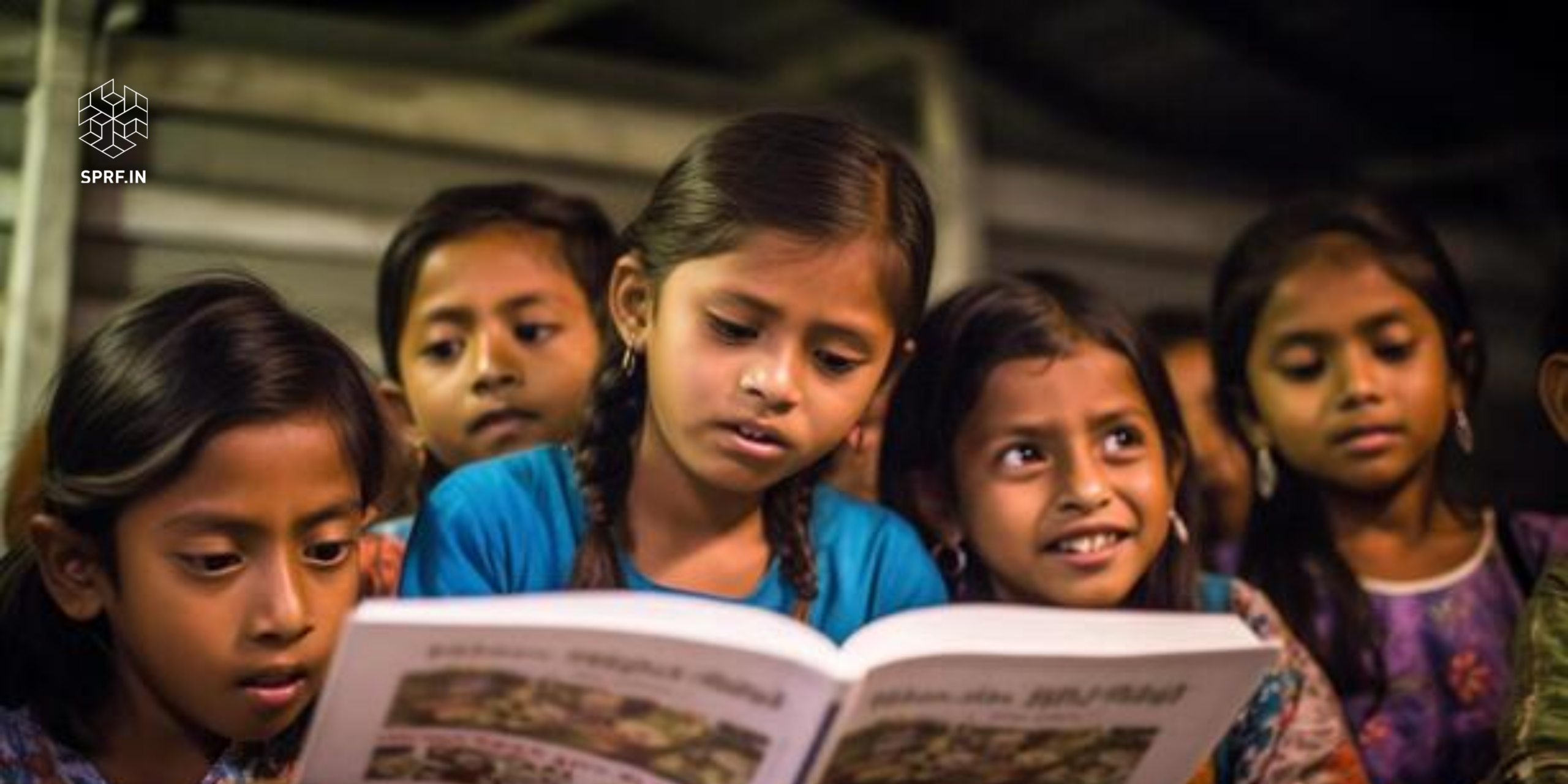
What is the purpose of a policy that does not resonate with the realities of the people it is made for?
The two faces of Delhi are evident to anyone who has found themselves stuck in the city’s traffic. On one hand, there are glossy shopping malls and wide roads that promise a ‘world-class’ city. On the other, there are settlements that line the roads, dense communities that tell a different story—one of struggle and survival. This duality is not accidental.
Delhi’s growth has been governed by the Delhi Master Plan, a document reimagined every two decades. It outlines the future of what the capital of India should look like. In practice, since independence, we have seen the Master Plans of 1962, 2001, 2021 and now the 2041 version. These plans articulate the government’s vision for a modern capital, yet the ground reality often tells a different story.
In fact, when you dissect these plans, and take a closer look, you can actually see the grand ambitions of the government and the policy thinking that influenced these plans.
This paper argues that Delhi’s infrastructure has been shaped by the political priorities underlying the Master Plans, leaving a complex and sporadic urban landscape. It compares policies related to slum rehabilitation and social housing across different Master Plans. It also highlights a parallel story: the survival and resilience of Delhi’s residents, who have developed their own knowledge-based governance systems to navigate gaps in official policy. The Master Plan 2041 (MPD-2041) should include these ground realities for a city to truly serve its people. To understand these complexities, let us take a closer look at the Delhi Master Plans.
An Introduction to Delhi Master Plans, from 1962-2041
Master Plan, 1962: The Ambitious Blue Print
The first Master Plan was born in a time of hope, post independence. Its goal was bold and clear: to prevent haphazard growth and ensure equitable development through the newly formed Delhi Development Authority (DDA) in 1957. It promised land and housing for all, especially the Economically Weaker Sections (Delhi Development Authority, 1962). Yet, from the very beginning, there was a gap between ambition and execution.
The DDA was tasked with acquiring land to build affordable housing. However, as scholar Gautam Bhan has pointed out, built 400,000 fewer homes than promised (Bhan, 2009). While the plan promised more homes, the reality was a chronic shortage, forcing waves of migrants and low-income residents to create their own solutions on the city’s fringes. These people then built informal settlements that the master plans deemed ‘illegal,’ but which were, in fact, a direct response to the state’s inability to provide. The state’s failure had given rise to a parallel city.
Master Plan 2001: Demolition and Denial
By the 1980s and ’90s, the language of planning changed. The Master Plan 2001 saw informal settlements as unauthorised developments and proposed measures such as removal, resettlement, or regularisation (Delhi Development Authority, 2001). In practice, the preferred approach was large-scale eviction and relocation to peripheral and barren sites far from employment, education, and essential urban services. This was the era of the Emergency and the Asian Games, when “beautification” was prioritized.
Case Study: The 1982 Asian Games
The 1982 Asian Games marked Delhi’s first attempt to project itself as a modern and cosmopolitan capital on the world stage. The event triggered sweeping changes across the city, including its infrastructure and planning priorities. The DDA and central ministries initiated large-scale projects, including the construction of stadiums, flyovers, and the Asiad Village. However, these projects came at the cost, one of displacing communities and bending long-term urban planning commitments.
The provisions of the Master Plan for Delhi (1962) that emphasised balanced land use, public housing, and the preservation of green spaces, were sidelined. Land earmarked for housing the urban poor was instead allocated to the Asiad Village, a high-income residential enclave later leased to private individuals and diplomats (Kundu, 1984; Baviskar, 2011). This shift reflected a pattern where the priorities of global image-building overshadowed the needs of affordable housing and inclusive development.
Labour laws were also unevenly enforced. Migrant construction workers were employed under precarious conditions without adequate housing or sanitation, despite statutory entitlements under the Contract Labour (Regulation and Abolition) Act, 1970 and the Inter-State Migrant Workmen Act, 1979 (Menon-Sen & Bhan, 2008). Reports documented widespread violations, including delayed wages and unsafe working environments (Kaviraj, 1991).
The Games demonstrated an early pattern: Delhi adopted the rhetoric of “world-class” infrastructure while undermining its own planning frameworks and legal protections. Short-term spectacle and global visibility were prioritised over sustainable, inclusive urban policy.
Master Plan 2021: The Shift in Language
The 2021 plan introduced a rhetorical shift, signaling recognition that eradication strategies had failed. Yet, it lacked enforceable mechanisms. Terms such as “untenable” remained undefined, allowing continued selective eviction practices. (Delhi Development Authority, 2007).
The timing coincided with the aftermath of the Commonwealth Games, when over 200,000 residents were displaced along Games corridors and sites like Yamuna Pushta (HLRN, 2011; Bhan, 2009). While the plan articulated rehabilitation, state practice continued to prioritize clearance. Labour protections for construction workers remained weak, with unsafe conditions, delayed wages, and inadequate housing persisted. (Menon-Sen & Bhan, 2008; Kaviraj, 1991).
Case study: Yamuna Pushta Settlements
The most striking example came with Yamuna Pushta. In the early 2000s, this was one of Delhi’s largest clusters of informal housing, home to nearly 150,000 people who keep Delhi running, from rickshaw pullers, construction workers, domestic workers, and street vendors. In 2004, the Delhi High Court ordered its complete demolition, arguing that the settlement polluted the Yamuna and encroached on its floodplain (Baviskar, 2011).
Yet this justification faltered under scrutiny. Scholars such as Amita Baviskar have shown that the main sources of pollution in the Yamuna were untreated sewage from planned colonies and industrial effluents, not the Pushta settlements (Baviskar, 2011). The environmental concern proved highly selective. Within years of the clearance, the same “ecologically sensitive” floodplain was used for the Akshardham temple complex, a metro depot, and luxury housing.
Those evicted were offered resettlement on the city’s margins, in places like Bawana and Savda Ghevra. These barren sites lacked basic services and were located far from work, schools, and hospitals. Families were uprooted, children pulled out of school, and long, costly commutes pushed many into permanent economic precarity. Rehabilitation became a sentence of hardship rather than a promise of dignity (Menon-Sen and Bhan, 2008; Baviskar, 2011).
Case Study: The Commonwealth Games
The pattern repeated itself during the 2010 Commonwealth Games. Research by the Human Rights Law Network (2011) documented how nearly 200,000 people were evicted across 19 sites in Delhi. Of these, nine were demolished for stadium construction, nine for “beautification” and “security,” and one to make way for a five-star hotel. In most cases, resettlement was absent. Even where plots were offered, families were pushed to distant peripheries, cut off from work and amenities (HRLN, 2011; Harms, 2012).
Ironically, many cleared sites remained vacant years later. However, for those displaced, survival meant long commutes, new debts, and in many cases, children leaving school to contribute to family income. Some families, unable to afford city life, were forced back to their villages, exiled from the very capital they had helped build (HRLN, 2011; Dasgupta, 2014).
This was no isolated incident. The demolition of the multigenerational settlement of Lal Khet near Vasant Kunj in 2004, adjacent to where the DLF Emporio Mall now stands, followed the same pattern (Dewan, 2004; Ghertner, 2015). The settlement was deemed “illegal” and a “nuisance,” while the luxury mall was celebrated as “planned” development, despite being in a protected green zone (Roy & Ong, 2011).
By the 2000s, Delhi’s planning regime had embraced the aesthetics of a “world-class city” defending the interests of capital and image-building. (Menon-Sen & Bhan, 2008; Chakravarty & Negi, 2016).
Master Plan 2041: The Repeating Loop? (MPD-2041)
The 2041 plan presents greater technical detail. It outlines norms for in-situ rehabilitation, including a 60/40 land-sharing model, Floor Area Ratio (FAR) regulations, and livelihood spaces. It also introduces regeneration of unauthorized colonies, acknowledging a longstanding urban reality (Delhi Development Authority, 2021).
Yet structural weaknesses remain. Terms such as “untenable,” “public purpose,” and “ecologically sensitive” continue to be undefined, creating space for selective interpretation. This has precedent: in Yamuna Pushta (2004), more than 35,000–40,000 households were evicted on environmental grounds, only for parts of the land to be later allocated to the Akshardham Temple and the Commonwealth Games Village (Baviskar, 2011; Dupont & Ramanathan, 2008; HLRN, 2004).
Institutional capacity is another concern. The DDA has historically fallen short by an estimated 400,000 units in its targets for EWS housing (Bhan, 2009). The complexity of MPD-2041 raises questions about whether the administrative apparatus can deliver on its commitments.
Financial provisions also remain untested. The plan relies on private participation through a 40% remunerative component, embedding tensions between public objectives and commercial priorities. At the same time, Delhi’s fragmented governance structure divided between central ministries, the state government, and the DDA continues to obstruct coordination. The expanded role of the Lieutenant Governor adds another layer of institutional complexity (Dupont & Ramanathan, 2008).
Taken together, MPD-2041 refines the vocabulary of inclusion and technical design but preserves the loopholes that historically facilitated exclusion. Without addressing definitional ambiguity and enforcement gaps, it risks repeating the trajectory of its predecessors.
Solutions Rooted in Ground Reality: How the City Really Works
While official policy oscillated between neglect and demolition, Delhi’s residents had another perspective. They saw this as an opportunity to develop adaptive, informal systems of governance that operate in the interstices of the formal state. This was not lawlessness but ingenuity. In clustered neighborhoods, local actors orchestrate everyday survival through subtle negotiation and knowledge of bureaucratic procedures: politicians ensure water tankers arrive in exchange for electoral support, communities negotiate to maintain electricity connections, and families use voter IDs and ration cards to assert residence and resist eviction (Benjamin, 2000; Chatterjee, 2004).
Scholars describe these practices as a “porous bureaucracy” (Benjamin, 2000), where street-level agreements bypass formal rules, and as a “political society” (Chatterjee, 2004), in which urban poor negotiate their place through collective pressure rather than relying solely on legal rights. This form of knowledge-based governance is rooted in deep local intelligence: people know which official to approach, what to say, and how to navigate a state that often overlooks them. Fragile, imperfect, and sometimes unjust, these informal systems nonetheless sustain the survival of a substantial portion of Delhi’s population.
Looking Forward: Pragmatic Recommendations
Based on this ground reality and the risk of repeating past mistakes, the MPD-2041 can adopt several pragmatic measures to enhance implementation:
- Precise Definitions: Establish clear, objective criteria for danger terms like “untenable”. Evictions should not be allowed unless absolutely necessary under verifiable safety risks by technical committees with multi-stakeholder representation.
- Bring People into the Process: Decisions about rehabilitation must include residents. Independent committees with community representatives can ensure that plans reflect real needs.
- Focus on Repair, Not Replacement: As suggested by Gautam Bhan (Bhan, 2009) we need to support what already exists. This can include upgrading services, regularizing settlements and so on—rioritising not a good city that looks perfect, but one where no one is left behind.
- Building public confidence: Create transparent tracking systems with civil society participation to monitor progress against stated targets, particularly for EWS housing. Public engagement ensures accountability and reinforces trust in the planning process.
- Independent Assessment: Establish technical review committees with academic and professional expertise to evaluate project viability before approval.
Conclusion: A City for All
Delhi’s story isn’t about a lack of plans. It’s about plans that exclude people. The MPD-2041 can change that, by seeing the city not as a problem to be solved, but as a community to be served.
The goal is not a world-class city. It’s a city that works for everyone. From the glossy malls to the bustling settlements, every corner of Delhi has a place in its future. It’s time the plan listened.
Ahmed, W. (2015). Neoliberal Utopia and Urban Realities in Delhi. ACME: An International Journal for Critical Geographies. https://acme-journal.org/index.php/acme/article/view/893.
Ahoobim, O., Goldman, L. and Mahajan, S. (2014). What Makes a “World-Class” City?. Stanford Social Innovation Review. https://ssir.org/articles/entry/what_makes_a_world_class_city.
Alluri, A. and Bhatia, G. (2015). The Decade that changed Delhi. Hindustan Times. https://www.hindustantimes.com/static/partition/delhi/.
Ananth, V. (2015). The evolution of the Land Acquisition Act. Mint. https://www.livemint.com/Politics/T2tN2OWzJIy9SuFgsGsmHN/The-evolution-of-the-Land-Acquisition-A ct-from-1824-to-2015.html.
Anwar, T. (2014). Delhi: Jhuggi Demolition leaves thousands roofless on cold winter night. Firstpost. https://www.firstpost.com/india/delhi-jhuggi-demolition-leaves-thousands-roofless-on-cold-winter-night-1 824081.html.
Batra, L. (2009). A Review of Urbanisation and Urban Policy in Post-Independent India. Centre for Study of Law and Governance, Jawaharlal Nehru University New Delhi. https://www.jnu.ac.in/sites/default/files/u63/12-A%20Review%20of%20Urban%20%28Lalit%20Batra%29 .pdf
Baviskar, A. (2011). What the Eye Does not See: The Yamuna in the Imagination of Delhi. Economic and Political Weekly, [e-journal] 46(50), 45–53. https://www.jstor.org/stable/41319483
Bayat, A. (2012). Politics in the City-Inside-Out. City & Society, [e-journal] 24(2), 110–128. https://doi.org/10.1111/j.1548-744X.2012.01071.x.
BBC News (1998). India: the economy. BBC News. http://news.bbc.co.uk/2/hi/south_asia/55427.stm
Benjamin, S. (2004). Urban Land Transformation for pro-poor economies. Geoforum, [e-journal] 35(2), 177–187. https://doi.org/10.1016/j.geoforum.2003.08.004.
Benjamin, S. (2008). Occupancy Urbanism: Radicalising Politics and Economy beyond Policy and Programs. International Journal of Urban and Regional Research. 32(3), 719–729. https://doi.org/10.1111/j.1468-2427.2008.00809.x.
Bhan, G. and Shivanand, S. (2013). (Un)Settling the City: Analysing Displacement in Delhi from 1990 to 2007. Economic and Political Weekly, 48(13), 54–61. https://www.jstor.org/stable/23391465.
Bhan, G. (2009). This is no longer the city I once knew”. Evictions, the urban poor and the right to the city in millennial Delhi. SAGE Journals, 21(1), 127-142. 10.1177/0956247809103009
Bhan, G. (2013). Planned Illegalities: Housing and the ‘Failure’ of Planning in Delhi: 1947-2010. Economic and Political Weekly, [e-journal] 48(24), 58-70. https://www.jstor.org/stable/23527393#metadata_info_tab_contents.
Bhan, G. (2019). Notes on a Southern urban practice. Environment and Urbanization, 31(2), pp. 639–654. https://doi.org/10.1177/0956247818815792.
Brenner, N. and Theodore, N. (2002). Cities and the Geographies of “Actually Existing Neoliberalism”. Antipode, 34(3), 349–379. https://doi.org/10.1111/1467-8330.00246.
Burakowski, A. and Iwanek, K. (2017). India’s Aam Aadmi (Common Man’s) Party: Are the Newcomers Rocking National Politics? Asian Survey, 57(3), 528–547. 10.1525/as.2017.57.3.528
Burchell, M., Gordon, C. and Miller, P. eds. (1991). The Foucault Effect. Chicago: The University of Chicago Press.
Caldeira, T. (2016). Peripheral urbanisation: Autoconstruction, transversal logics, and politics in cities of the global South. Environment and Planning D: Society and Space, 35(1), 3–20. https://doi.org/10.1177/0263775816658479.
Chakravarty, S. and Negi, R. eds. (2016). Space, Planning and Everyday Contestations in Delhi. Springer.
Chattaraj, D., Choudhury, K. and Joshi, M. (2017). The Tenth Delhi: economy, politics and space in the post-liberalisation metropolis. Decision, 44(2), 147–160. 10.1007/s40622-017-0154-8
Chatterjee, P. (2004). The Politics of the governed: reflections on popular politics in most of the world. New York: Columbia University Press.
Cowan, T. (2018). The Urban Village, Agrarian Transformation, and Rentier Capitalism in Gurgaon, India. Antipode, 50(5), 1244–1266. https://doi.org/10.1111/anti.12404.
Cowan, T. (2019). The village as urban infrastructure: Social reproduction, agrarian repair and uneven urbanisation. SAGE Journals, 4(3), 736–755. https://doi.org/10.1177/2514848619868106
Centre for Policy Research India. (2015.) The Intersection of Governments in Delhi. New Delhi: Centre for Policy Research India.
Dasgupta, R. (2014). Capital: The eruption of Delhi. New York: The Penguin Press.
Deb, N. (2020). Book Review: Dispossession without Development: Land Grabs in Neoliberal India by Michael Levien. LSE Review of Books. https://blogs.lse.ac.uk/lsereviewofbooks/2020/06/23/book-review-dispossession-without-development-la nd-grabs-in-neoliberal-india-by-michael-levien/
Deva, S. (1986). Bureaucracy and Development. Economic and Political Weekly, 21(48), M149–M155. https://www.jstor.org/stable/4376385.
Delhi Development Authority (DDA). (1962). Master Plan for Delhi 1962. New Delhi: Delhi Development Authority.
Delhi Development Authority (DDA). (2001). Master Plan for Delhi 2001. New Delhi: Delhi Development Authority.
Delhi Development Authority (DDA). (2007). Master Plan for Delhi-2021. New Delhi: Delhi Development Authority.
Delhi Development Authority (DDA). (2021). Draft Master Plan for Delhi-2041. New Delhi: Delhi Development Authority.
Dewan, G. (2004). Dispossession in Lal Khet (in Delhi ridge). Architexturez South Asia, https://architexturez.net/doc/az-cf-21764.
Dewan, G. (2004). Wilful dispossession for wilful development on Yamuna riverbed. Architexturez South Asia, https://architexturez.net/doc/az-cf-21748
Dharwadker, A. (2022). Dystopia’s Ghost. Places Journal, https://placesjournal.org/article/architecture-power-and-nationalism-in-india/?cn-reloaded=1&cn-reloade d=1.
Dupont, V. (2008). Slum Demolitions in Delhi since the 1990s: An Appraisal. Economic and Political Weekly, 43(28), 79–87.
https://www.jstor.org/stable/40277717#metadata_info_tab_contents
Fernandes, B.G. (2006). Making Delhi a Better Place: Promoting a Vision of Urban Renaissance. New Delhi: Kalpaz Publications.
Garg, M., 1993. Delhi’s two faces: One rich, the other poor. Down to Earth, [online] 15 May. <https://www.downtoearth.org.in/blog/delhis-two-faces-one-rich-the-other-poor-30938> [Accessed 3 September 2022].
Ghertner, D.A., 2011. Gentrifying the State, Gentrifying Participation: Elite Governance Programs in Delhi. International Journal of Urban and Regional Research, [e-journal] 35(3) pp. 504-532. https://doi.org/10.1111/j.1468-2427.2011.01043.x
Ghertner, D.A., 2014. India’s Urban Revolution: Geographies of Displacement beyond Gentrification. Environment and Planning A: Economy and Space, [e-journal] 46 (7), pp. 1554-1571. https://doi.org/10.1068/a46288.
Ghertner, D.A., 2015. Rule by Aesthetics: World-Class City Making in Delhi. [Kindle Edition] Oxford University Press. Amazon.in <https://www.amazon.in/> [Accessed 3 September 2022].
Guha, S.B., 2013. Accumulation and Dispossession: Contradictions of Growth and Development in Contemporary India. Journal of South Asian Studies, [e-journal] 36(2), pp. 165-179. https://doi.org/10.1080/00856401.2013.804026
Gupta, S., 2020. All you need to know about Delhi Development Authority (DDA). [online] <https://housing.com/news/dda-delhi-development-authority/> [Accessed 30 August 2022]
Harms, E., 2012. Beauty as control in the new Saigon: Eviction, new urban zones, and atomised dissent in a Southeast Asian city. american ethnologist: Journal of the American Ethnological Society, [e-journal] 39(4), pp. 735-750. https://doi.org/10.1111/j.1548-1425.2012.01392.x
Harvey, D., 2004. The ‘New’ Imperialism: Accumulation by Dispossession, [online] <https://socialistregister.com/index.php/srv/article/view/5811> [Accessed 29 August 2022].
Human Rights Law Network (HRLN), 2011. Planned Dispossession: Forced Evictions and the 2010 Commonwealth Games. New Delhi: Housing and Land Rights Network.
India Today, 2022. Delhi’s IGI airport is now world’s second busiest airport. India Today, [online] 2 May.
<https://www.indiatoday.in/cities/delhi/story/delhi-news-igi-airport-second-busiest-world-official-airline-guid e-1944447-2022-05-02> [Accessed 6 September 2022]
Jessop, B., 2002. Liberalism, Neoliberalism, and Urban Governance: A State-Theoretical Perspective. Antipode, [e-journal] 34(3), pp. 452-472. https://doi.org/10.1111/1467-8330.00250.
Jessop, B., 2013. Putting neoliberalism in its time and place: a response to the debate. Social Anthropology, [e-journal] 21(2), pp. 65-74. https://doi.org/10.1111/1469-8676.12003.
Kaviraj, S., 1991. The Imaginary Institution of India. In R. Guha, ed. Subaltern Studies IX: Writings on South Asian History and Society. Oxford University Press.
Kennedy, L., 2020. Actors and shifting scales of urban governance in India. HAL Open Science. [online] <https://halshs.archives-ouvertes.fr/halshs-03044381/document> [Accessed 3 September 2022].
Khan, M.H., 2007. Governance, Economic Growth and Development since the 1960s. [pdf] United Nations Department of Economic and Social Affairs.
<https://www.un.org/esa/desa/papers/2007/wp54_2007.pdf> [Accessed 3 September 2022].
Khosla, R., 2015. The New Metropolis: Nehru and the Aftermath. Social Scientist, [online] <https://www.jstor.org/stable/pdf/24372933.pdf?refreqid=excelsior%3Ac8dfacb839fd760fd6bdd25dfaf3 9b4d&ab_segments=&origin=&acceptTC=1 > [Accessed 3 September 2022].
Kishore, R., 2020. The (Un)governable City: Productive Failure in the Making of Colonial Delhi, 1858-1911. Hyderabad: Orient Blackswan.
Kundu, D. and Pandey, A., 2021. Sustainable urbanisation in India and Delhi: Challenges and Way Forward. In: ASEF (Asia-Europe Foundation) Education Department, 23rd ASEF Summer University on ‘Liveable Cities for a Sustainable Future’. Online, September 2021. ASEF Education Department.
Levien, M., 2018. Dispossession without Development. [Kindle Edition] Oxford University Press. Amazon.in <https://www.amazon.in/> [Accessed 3 September 2022].
Lewallyn, T., 2022. Poverty in Delhi: Rich Delhi, Poor Delhi. The Borgen Project, [blog] 22 January. <https://borgenproject.org/poverty-in-delhi/> [Accessed 3 September 2022].
Naik., G. 2021. Book Review: The (Un)Governable City: Productive Failure in the Making of Colonial Delhi, 1858-1911 by Raghav Kishore. LSE Review of Books, [blog] 5 August. <https://blogs.lse.ac.uk/lsereviewofbooks/2021/08/05/book-review-the-ungovernable-city-productive-failur e-in-the-making-of-colonial-delhi-1858-1911-by-raghav-kishore/> {Accessed 3 September 2022].
Kundu, D., Pandey, A. and Sharma, P., 2018. India: National Urban Policies and City Profiles for Delhi and Madurai. [online] GCRF Centre for Sustainable, Healthy and Learning Cities and Neighbourhoods (SHLC).
<http://www.centreforsustainablecities.ac.uk/wp-content/uploads/2018/10/Research-Report-India-National -Urban-Policies-and-City-Profiles-for-Delhi-and-Madurai-FINAL.pdf> [Accessed 29 Aug 2022].
News Nine, 2022. AAP’s ‘freebies’ politics shrunk Delhi revenue surplus by 88% in 10 years, says report. News Nine, [online] 21 August.
<https://www.news9live.com/india/aaps-freebies-politics-shrunk-delhi-revenue-surplus-by-88-in-10-years says-report-190758?infinitescroll=1> [Accessed 6 September 2022].
NITI Ayog, 2021. Reforms in Urban Planning Capacity in India. [pdf] New Delhi: NITI Ayog. <https://www.niti.gov.in/sites/default/files/2021-09/UrbanPlanningCapacity-in-India-16092021.pdf> [Accessed 3 September 2022].
PTI, 2021. Lok Sabha passes bill that gives more powers to Delhi L-G. The Print, [online] 22 March. <https://theprint.in/india/lok-sabha-passes-bill-that-gives-more-powers-to-l-g/626435/> [Accessed 3 September 2022]
Raheja,G., Borgmann, K. and Pillai, S., 2015. Urban Transformation in Leftover Spaces: A case study of Dilli Haat. SSS10, 10th International Space Syntax Symposium. London, 13-17 July. London: 10th International Space Syntax Symposium.
Robb, P., 1981. British Rule and Indian “Improvement”. The Economic History Review, [e-journal] 34(4), pp. 507-523. https://doi.org/10.2307/2595587.
Rose, N. and Miller, P., 2010. Political power beyond the State: problematics of government. The British Journal of Sociology, [e-journal] 61(1), pp. 271-303. https://doi.org/10.1111/j.1468-4446.2009.01247.x
Roy, A. and Ong, A., 2011. Conclusion: Postcolonial Urbanism: Speed, Hysteria, Mass Dreams. In Worlding Cities: Asian Experiments and the Art. Of being Global. A. Roy and A Ong, eds. 2011. Chichester: Blackwell Publishing. pp. 307-335.
Roy, A., 2009. The 21st-Century Metropolis: New Geographies of Theory. Regional Studies, [e-journal] 43(6), pp. 819-830. https://doi.org/10.1080/00343400701809665.
Roy, A., 2011. Slumdog Cities: Rethinking Subaltern Urbanism. International Journal of Urban and Regional Research, [e-journal] 35(2), pp. 223-238. 10.1111/j.1468-2427.2011.01051.x
Sharma, B.K, 2012. Jawaharlal Nehru’s Model of Development. Indian History Congress, [online]
<https://www.jstor.org/stable/pdf/44156330.pdf?refreqid=excelsior%3A1e1b7d26c1cea3ad0308d7ba99dcf 833&ab_segments=&origin=&acceptTC=1> [Accessed 30 August 2022]
Shatkin, G., 2007. Global Cities of the South: Emerging perspectives on growth and inequality. Cities, [e-journal] 24(1), pp. 1-15. 10.1016/j.cities.2006.10.002
Shatkin, G., 2013. Contesting the Indian City: Global Visions and the Politics of the Local. [Kindle Edition] Wiley-Blackwell. Amazon.in <https://www.amazon.in/> [Accessed 6 September 2022].
Sheikh, S. and Banda, S., 2015. Categorisation of Settlement in Delhi. [pdf] New Delhi: Cities of Delhi. <https://cprindia.org/wp-content/uploads/2021/12/Categorisation-of-Settlement-in-Delhi.pdf> [Accessed 6 September 2022].
Storper, M. and Scott, AJ., 2014. The Nature of Cities: The Scope and Limits of Urban Theory. International Journal of Urban and Regional Research, [e-journal] 39(1), pp. 1-15. https://doi.org/10.1111/1468-2427.12134.
Storper, M. and Scott, AJ., 2016. Current debates in urban theory: A critical assessment. Urban Studies, [e-journal] 53(6), pp. 1114-1136. https://doi.org/10.1177/0042098016634002.
Vasudev, E., 2021. Disempowering Delhi’s Urban Poor by Empowering the LG. The Leaflet, [online] 26 April. <https://theleaflet.in/disempowering-delhis-urban-poor-by-empowering-the-lg/> [Accessed 3 September 2022]
Wacquant, L., 2010. Crafting the Neoliberal State: Workfare, Prisonfare, and Social Insecurity. Sociological Forum, [online]
<https://www.jstor.org/stable/40783391#metadata_info_tab_contents> [Accessed 6 September 2022]
Wacquant, L., 2012. Three steps to a historical anthropology of actually existing neoliberalism. Social Anthropology, [e-journal] 20(1), pp. 66-79. https://doi.org/10.1111/j.1469-8676.2011.00189.x
Waldrop, A., 2008. Gating and Class Relations: the case of a New Delhi “colony”. City & Society, [e-journal] 16(2), pp. 93-116. 10.1525/city.2004.16.2.93
Zhang, L., & Ong, A. eds., 2008. Privatising China: Socialism from Afar. [e-book] Cornell University Press. <http://www.jstor.org/stable/10.7591/j.ctt7zjpj> [Accessed 29 August 2022].


 Vedika Bakshi holds a Master’s in Development Studies from SOAS, University of London, where her research focused on urban development in India. A law graduate from Jindal Global University, she currently works in the social impact sector and writes on governance, sustainability, and inclusive development.