Introduction
The Yamuna’s pollution is largely contributed to by untreated sewage. It has been largely reported that the Najafgarh and the Shahdara drain contribute significantly to the pollution of the river along its Delhi stretch.
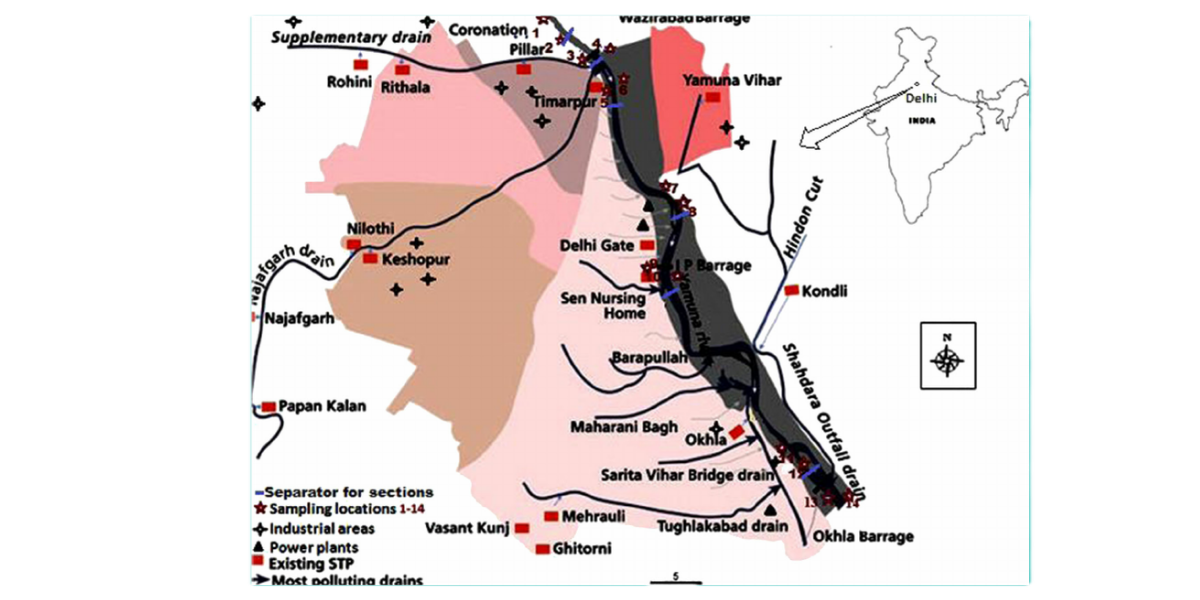
The Najafgarh drain, which runs across the southwest part of the city, ultimately meets the river at Wazirabad. The Najafgarh drain is originally an extension of the Sahibi River and was constructed to carry the stormwater. On the other hand, the Shahdara drain, which flows across East Delhi, was created for flood control following the floods in 1961. It joins the Yamuna downstream from the Okhla barrage near Noida. The Najafagarh drain and the Shahdara Drain together contribute nearly 80% of the pollution load from domestic wastewater, untreated wastewater from industries, and solid waste. Looking at specific pollution hotspots, such as Najafgarh and Shahdara, which are often singled out in the discourse over the Yamuna, is necessary because they account for a disproportionate share of Delhi’s pollution. Focusing on them helps identify the exact institutional and infrastructural failures, such as overloaded sewage connections, underperforming STPs,s and unauthorised colonies that contribute to overall river degradation.
Najafgarh: Unchecked Pollution
The Najafgarh drain passes through highly polluted areas with industries located along its course, which directly dump hazardous waste into the drain. As of January 2023, the BOD level of the drain was 53 mg/l, which should be nearly 3 mg/l, it is thus classified as a Category D under wetland classification by the Central Pollution Control Board.
The drain passes through Sagarpur, collecting the sewage from the Delhi cantonment area, and through localities in Dwarka, where it collects household wastewater and solid waste. Moreover, as the CPCB found in its 2018 study, the Najafgarh basin also became part of the second most polluted cluster in India, with not only severe pollution in the drain but also air and soil toxic content reaching “critical” and “severe” categories, respectively. This is also because it passes through industrial areas such as Anand Parbat, Naraina, Okhla, and Wazirpur. Despite the mandates and orders by the NGT, many illegal dyeing units that are based in Gurgaon continue to operate, and their toxic effluents are released in the stormwater drain.
What makes Najafgarh particularly complex is its sheer scale. It’s not just one drain but rather a massive system collecting water from 126 smaller drains.
This level of alarming level of pollution has reportedly led to fish kills in the drain in 2022. An urban drainage channel study found that the Najafgarh drain was contaminated with high plastic contamination in the range of 5400 and 2400 MPs/m3 during pre-and post monsoon, which included fragments, films, pellets, foam, and fibres.
The nexus of these factors, including the scale of pollution, the infrastructure gaps in areas around the Najafgarh drain, particularly unauthorised colonies which are connected to STPs make Najafgarh a key source of pollution to the Yamuna.
Shahdara Drain: The Interstate Pollution Problem
The Shahdara Drain is the second biggest contributor to the Yamuna pollution, contributing nearly 11% of all wastewater that enters the Yamuna. Nearly 45% of the dirty water flowing through Shahdara originates from Uttar Pradesh, specifically from areas such as Sahibabad, Indirapuri, and Banthala. Furthermore, the drain also carries the load of lots of industrial waste from Loni and Sahibabad industrial township, and the Loni drain.
This creates a unique challenge. Delhi authorities can regulate industries and households within Delhi, but they have limited control over what flows in from another state.
The DPCC August report of the river pollution found that the Shahdara drain’s confluence into the Yamuna increased the chemical oxygen demand (COD) of the water samples to 52 mg/l, which is worse than all other points in the Delhi stretch.
The pollution levels in Shahdara are staggering. Recent measurements show BOD levels between 100 and 159 mg/L, sometimes making it even more polluted than Najafgarh on certain days. The drain runs through Delhi, Ghaziabad, and Noida, running along key areas, including the Swami Dayanand Marg and several residential areas of East Delhi, including Patparganj, Preet Vihar, Jagatpuri, and Gandhi Nagar.
Key Reasons for Pollution from Najafgarh and Shahdara Drains
Three main factors explain why these two are in a league of their own when it comes to pollution.
Firstly, it is sheer scale. Najafgarh alone discharges 68.71% of all wastewater entering the Yamuna from Delhi, and Shahdara adds another 10.90%. Together they account for nearly 80% of the total pollution load. All other drains combined contribute only about 20%.
Second is source diversity. Both mega drains collect wastewater from numerous sub-drains, and these sub-drains carry all kinds of pollution: domestic sewage from homes, industrial chemicals from factories, agricultural runoff with pesticides and fertilizers, waste from dairies and livestock, and solid waste, including plastics. This creates incredibly complex contamination profiles. Smaller drains, in contrast, usually have more uniform pollution sources. Many carry primarily domestic sewage from residential areas, making them easier to treat with standard methods.
Third is the interstate pollution dimension. Shahdara receives 45% of its flow from Uttar Pradesh, bringing untreated sewage from cities beyond Delhi’s jurisdiction. Najafgarh receives contributions from Haryana through various tributaries.
Although the governments, including the UP government, have created a vision to control the pollution of the Shahdara drain by 2027, and the Delhi government has also announced plans to increase sewage treatment capacity to 1,500 MGC by 2028. This requires concerted effort on many fronts.
The Upshot
Delhi’s drain pollution is not evenly distributed. While the city has 22 major drains, just two of them, Najafgarh and Shahdara, account for nearly 80% of all pollution entering the Yamuna. These two drains are fundamentally different from smaller drains in Delhi. Since both the Najafgarh and Shahdara drains are too large to be tapped and diverted, they were not covered under the Interceptor Sewer Program.
A 2017 study on the Impacts of Shahdara Drain on Noida city and the Yamuna River collected samples from the drain at different accessible points. The study suggested the construction of STP at the outfall location and an artificial permanent wetland that can treat anthropogenic discharge during plants such as reeds (Juncus effusus, Iris spp, umbrella pams (Cyperus alternifolius), etc.
Apart from the upgradation and regulation of existing STPs that do not meet the standards, there is a grave need to bring unauthorized colonies into the purview of the law. Unauthorized colonies and slums often lack a formal sewage system, so wastewater dumped into these open drains is unaccounted for. To meet these demands, decentralized solutions for small-scale sewage treatment should be looked at that can treat domestic waste at the source.
One crucial gap is that there is an inaccuracy in the existing estimates of how much sewage is generated in Delhi. The CSE has explicitly called out the absence of reliable wastewater data on generation, faecal desludging, or even water consumption. Unreliable data cannot be the basis of city planning and governance.