Eliminating Female Anaemia in India: Prevalence, Challenges and Way Forward

INTRODUCTION

India’s 94th rank in the 2020 Global Hunger Index (2021) out of 107 reflects the rampant undernourishment in the country. While the economy has witnessed rapid growth in the past decades, improvements in nutrition status have been relatively steady, and hence, the need for substantial breakthroughs remains. A critical aspect of this public health challenge is the anaemia burden on women in India, recording one of the world’s highest. 

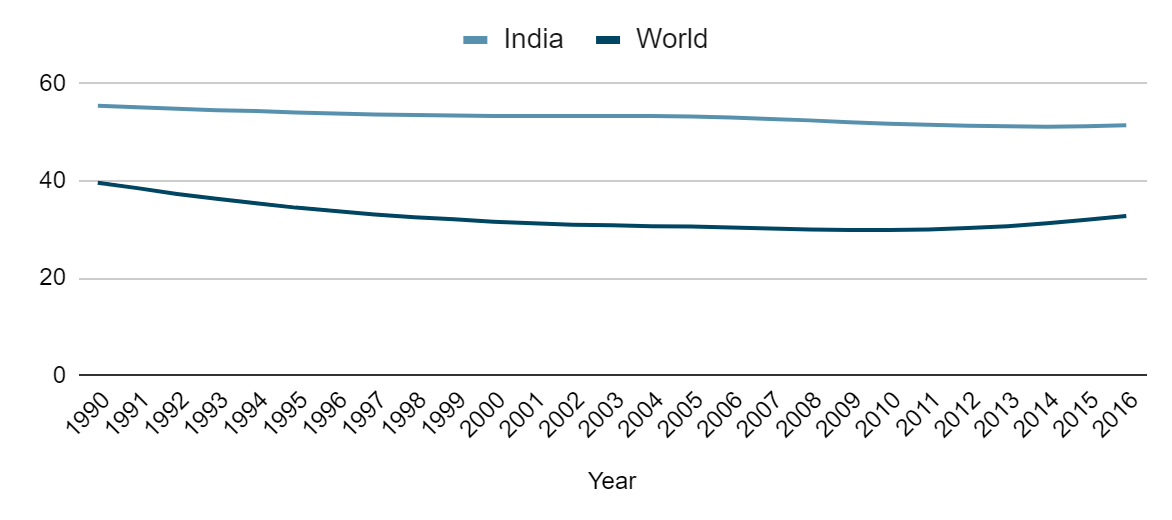
Although there are several causes of anaemia, foremost is iron deficiency, followed by deficiencies in folate, vitamin B12, and vitamin A (World Health Organisation n.d.). In the last two decades, anaemia’s prevalence among Indian women of reproductive age, on average, has been 20% more than the world average. While one in three women in the world is anaemic, one in two women is anaemic in India.


Figure 1: Prevalence of anaemia among women of reproductive age (% of women ages 15-49)
Anaemia in Indian Women
Source: The World Bank Data 2016

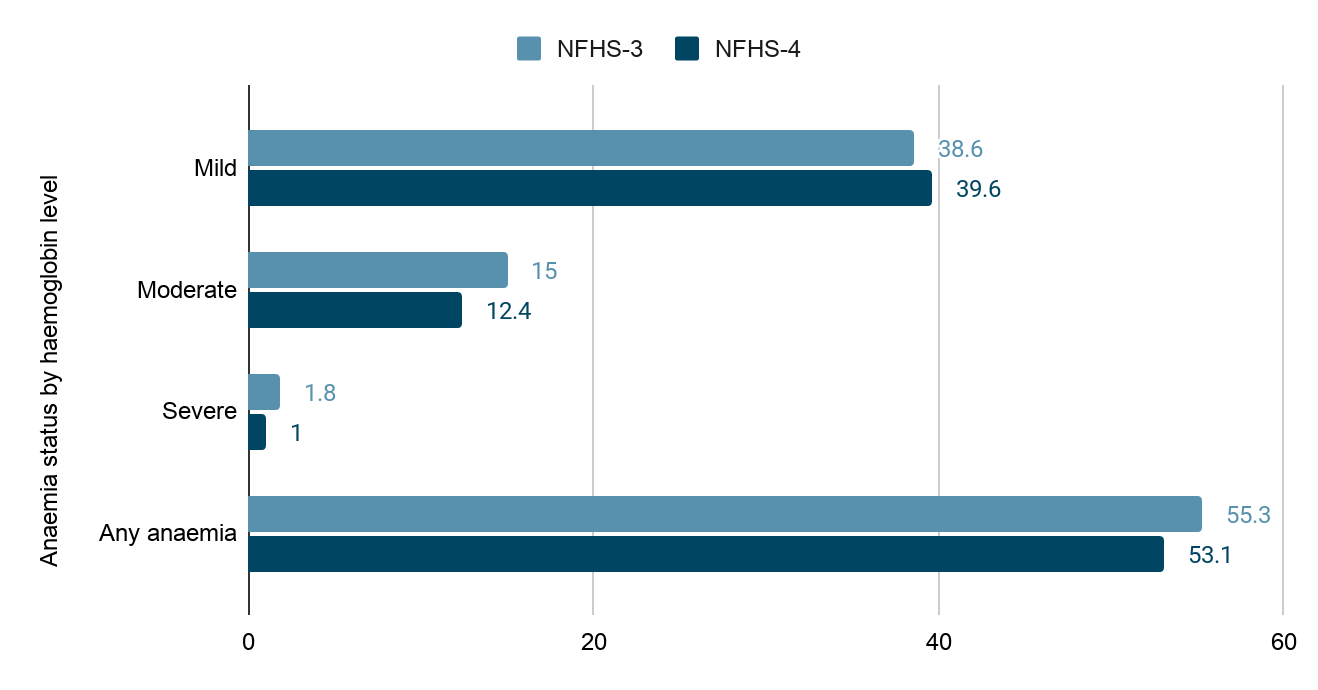
According to the National Family Health Survey 2015-2016 [NFHS-4] data, approximately half of total women in India suffer from anaemia of some kind (mild, moderate, or severe), which is not a significant improvement from the NFHS-3 [2005-6] findings (Ministry of Health and Family Welfare [MoHFW] 2017). While severe and moderate anaemia have seen a fall, cases in mild anaemia have increased. Such a condition can have serious physical, social, and economic consequences as it leads to fatigue, stress, and diminished productivity. Chronic anaemia can also lead to cardiac failure and death (Bharati et al., 2008: 348). 


Figure 2: Percentage of women age 15-49 with anaemia – NFHS-4 vs NFHS-3
Anaemia in Indian Women
Source: Ministry of Health and Family Welfare [MoHFW] 2017: 335
During pregnancy, a woman needs an extra intake of 15mg of iron per day to support herself and the baby, the lack of which increases the risk of maternal mortality (Ministry of Women and Child Development 2018). India does not perform well in maternal health and birth weight of newborns as well. While half of all global maternal deaths due to anaemia occur in Southeast Asia, 80% of them happen in India (National Health Portal n.d.). A study by Gnanasekaran et al. (2019) found that maternal anaemia is positively correlated with low birth weight babies as 85% of low birth weight babies were born to anaemic mothers.


Default Author Image

Akshita Sharma

Found this post insightful? Share it with your network and help spread the knowledge.

Suggested Reads

The Growing Cost of Fast Fashion and Synthetic Clothing

Introduction  India’s textile industry is 5,000 years old and remains the “spinning wheel” of the country’s industrial and economic growth. As a global leader in fibre-to-fashion, India accounts for 4 per cent of global textile and apparel trade (Department of Textiles, Government of Maharashtra, and Primus Partners, 2025). Behind those numbers lies a reality of […]

Demystifying Petrol Prices in India (2017–2026): Taxation, Price Transmission, and State-Level Divergence

Introduction  To categorise petrol as being just another commodity, would understate its significance. Long before it became a household expense, it served as an instrument of industrial expansion, military strategy, and statecraft. From the oil shocks of the 1970s to the Gulf Wars and more recently, the disruptions following the Russia–Ukraine and West Asia conflicts, […]

Forest-Dwelling Indigenous Communities, Land Rights, and Conflicts

Forest-dwelling communities share a deep relationship with nature, but more than that, they bear witness to history and provide insight into the management of forests. According to the State of Forests Report of 2019, approximately 300 million people are dependent on forests in India (PIB Delhi, 2023). The romanticisation of indigenous, forest-dwelling communities often limits […]

Integrated Solutions for Interconnected Challenges: Building Climate Resilience in India

Rising global temperatures are intensifying climate hazards at an unprecedented rate. In 2025, the global annual average temperature increase reached 1.44 ± 0.09 °C (2.60 ± 0.17 °F) above the pre-industrial period, making it the third warmest year on record (Berkeley Earth, 2026). India, among the most climate vulnerable countries, experienced extreme weather events on 99 […]

India-UK Vision 2035: A Renewed Defence Partnership

Introduction The recently concluded India-UK Free Trade Agreement (FTA) is a landmark deal in the growing strategic partnership between the two countries across wide-ranging industries including fintech, renewable energy, education, and even film production. A key aspect of this revitalised economic relationship is the ‘India-UK Vision 2035’, a roadmap for renewed defence partnership, forging a […]