When James Augustus Hicky launched the Bengal Gazette, the first newspaper published in India in 1780, disputes soon arose between him and the colonial authorities, leading to his prosecution and imprisonment (Press Information Bureau, 2017; Press Information Bureau, 2026). Media history in India has been shaped by developments in each century, with each change raising questions about the actors involved in producing, disseminating, and controlling information.
After newspapers, radio brought another shift through analogue technology, resulting in the first news broadcast in India from the Bombay station on 23 July 1927. The government later took control of the radio service in 1930 and renamed it All India Radio in 1936 (Prasar Bharati, 2026). In 1959, television, an audio-visual mass medium, started as an experimental public-service broadcast, before becoming a regular service in 1965 and eventually separated from All India Radio in 1976 (Prasar Bharati, 2022). When the winds of change blew again, private satellite television entered after economic liberalisation, and India’s broadcasting system, previously mostly state-controlled, shifted significantly. Star TV entered the scene in 1991, followed by Zee TV in 1992 and Sony Entertainment Television in 1995 (Press Information Bureau, 2025). The newest entry is the artificial intelligence that is driving the latest change in the media space (Krishnan, 2026).
Calling these changes merely technological may be unwise, as newer technology broadens dissemination, reach, and press freedom. In contrast, the trend seems to be opposite, with India ranking 157th out of 180 countries in the 2026 World Press Freedom Index. Political pressure, media concentration, and attacks on press freedom remains the largest concern cited in the largest democracy (Reporters Without Borders, 2026). The problems facing press freedom, however, also go beyond legislation which directly controls broadcasting and digital content. The Digital Personal Data Protection Act, 2023, and its accompanying rules have raised concerns about journalists’ ability to obtain and publish information for the public good. Platforms and organisations like Reporters Without Borders have time and again cautioned that developments like these might limit access to administrative documents and public records. This, along with the fact that a public-interest provision has been deleted from the Right to Information Act has given rise to concerns about the ability to supervise public officials and institutions (Reporters Without Borders, 2026).
At the same time online platforms, including video platforms, are increasingly shaping India’s news environment. 58 per cent of the people get their news from YouTube, and 39 per cent overall trust the news they hear or watch or read, a four-point drop compared with the previous year. Independent journalists and individual content creators are competing with traditional news organisations for public attention. Yet, the state continues to gain more control, through its patrons, over the media landscape. This has resulted in 52 per cent of people saying that they sometimes avoid news altogether, suggesting the problem facing news organisations is no longer simply providing information but also holding people’s attention and trust (Egan et al., 2026)
The role of the news gatekeeper is no longer limited to an editor, a broadcaster, or a platform; it is increasingly an algorithmic system whose operations are difficult for users to see or evaluate. These changes have not only altered how Indians get their news but also reorganised the institutional arrangements for producing, distributing, and regulating news with AI adding another dimension to the media space. 22 per cent of Indians use AI chatbots for news, more than twice the global average of 10 per cent (Egan et al., 2026). Although AI is still a minor news source compared with social media and video platforms, it matters because it creates a new intermediary between the public and journalism. Rather than depending on a newspaper, a broadcaster, or a social-media feed, users can now ask an AI system to select, summarise, and explain information for them.
The New Problem of Verification
Media organisations are aggressively using AI for transcription, translation, summarisation, data analysis and identifying potential investigative leads. Studies have pointed out that 96% of publishers considered improving operational efficiency a priority for generative AI, while 73% were using or experimenting with AI for newsgathering functions (Newman, 2025). AI is slowly becoming a vital clog of the journalistic process in itself with news channels like Odisha TV and Aaj Tak experimenting with AI anchors and AI clones of popular news anchors.
As generative AI can generate realistic text, images, audio, and video at a low cost, it is adding a new challenge since it doesn’t just alter who is able to produce news but also makes it easier to create false information. According to the Reuters Institute’s Digital News Report 2026, 62% of the people worldwide are worried about the genuinity of information and media that is available online, and general trust in the news remains at 37%. The immediate transformation towards increased use of AI may not be the replacement of journalists, but the incorporation of AI into everyday newsroom work. AI may assist journalists with processing information, but responsibility for verification, sourcing and editorial judgement must remain with identifiable people and institutions. Regulation must therefore address not just the removal of harmful content but also promote transparency, establish provenance and clarify the lines of editorial accountability.
From Producing News to Sustaining Journalism
There is another aspect of the AI transformation is the economic sustainability of journalism. The difficulties now facing news organisations are not merely those relating to content or technology, but also concern the way in which journalism is financed. AI is likely to exacerbate this change by making advertising, audience targeting and content distribution more and more personalised.
According to the Global Entertainment & Media Outlook 2026–2030, the global entertainment and media industry is expected to amount to US$4.2 trillion by 2030, and digital and traditional advertising revenues, which passed US$1 trillion in 2025, are projected to reach US$1.4 trillion by 2030 (PwC, 2026). AI-powered advertising is expected to play an important role in this growth. For journalism, however, increased efficiency does not necessarily mean greater institutional security. Although AI can lower the costs of producing and distributing content, it does not eliminate the costs which enable independent journalism such as on-the-ground reporting, keeping an editorial staff, carrying out investigations and building up relationships with sources and communities.
If advertising and audience attention tend to move towards the platforms and their automated recommendation systems, news organisations may end up producing more content while securing less of the economic value created by that content. The result could be especially severe for local and independent journalism, since these areas already have narrow financial margins.
This brings up a significant issue for the future of media policy. Just because journalists are legally allowed to publish does not mean that a media system can stay without any check. It is important to protect the public from misinformation, equally important that the media works without intimidation, censorship and the regulatory framework does not inadvertently undermine the economic sustainability of journalism.
The Unequal Cost of Regulation
This evolving media environment poses a specific challenge for India’s media organisations. The Government of India proposed the Broadcasting Services (Regulation) Bill 2023 which aims to place a wide variety of broadcasting and digital content under a single regulatory framework, raising key concerns: can rules which have been drawn up for traditional broadcasters properly deal with a media ecosystem in which an individual creator, a digital publisher, a social-media platform and an AI system might all be involved in producing and distributing the same piece of information?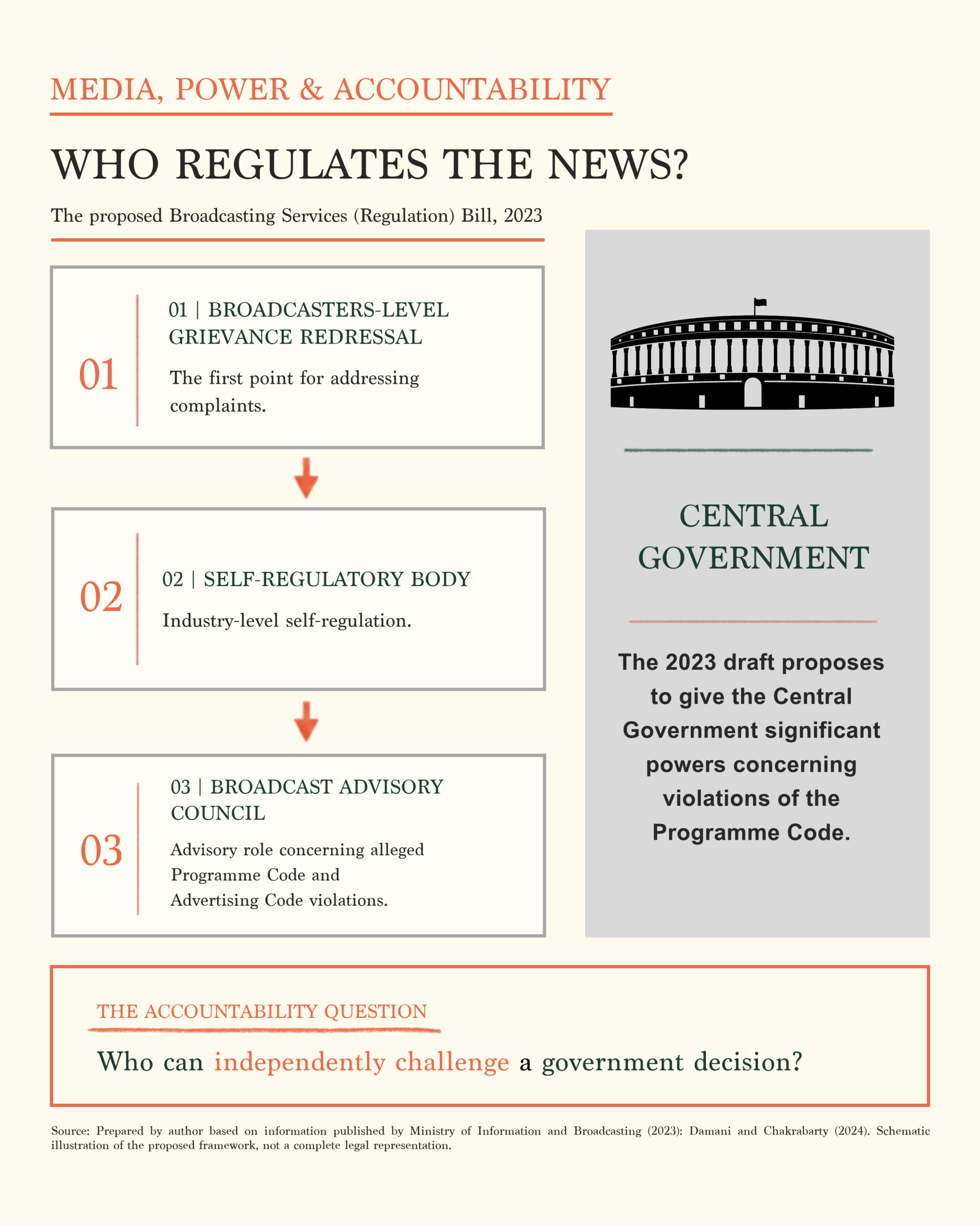 Fig 1. An overview of the proposed regulatory framework under the Broadcasting Services (Regulation) Bill, 2023.
Source: Compiled by author based on information from Ministry of Information and Broadcasting (2023); Damani and Chakrabarty (2024), PRS Legislative Research.
The 2023 draft suggested a three-tier regulatory structure for broadcasting services, comprising self-regulation by broadcasters and a Broadcast Advisory Council, as well as granting the Central Government considerable powers in respect of violations of the programme code (Ministry of Information and Broadcasting, 2023). The concern is not that digital media should be left entirely unregulated but whether regulation can still be proportionate when the institutional capabilities of the entities being regulated are so unequal. For example, a large television network is able to keep legal, editorial and compliance teams; an independent journalist or a small digital content producer may have no more than a camera, a laptop and a social-media account. It follows that imposing similar compliance requirements on all these actors could therefore result in barriers to entry, since technological change is at the same time reducing the cost of producing and distributing news.
While the 2023 draft bill proposes a three-tier regulatory system, it gives the Central Government considerable powers with regard to violations of the programme code (Ministry of Information and Broadcasting, 2023). These questions become even more important when one takes into account India’s overall record on press freedom. This is why the question of independent oversight becomes particularly important.
Regulation is necessary in any media system, especially when broadcasters and digital platforms can spread misinformation, hate speech or harmful content rapidly. The difficulty in this case arises when the organisation responsible for enforcing these rules is also part of the executive government, especially in a media environment where the distinction between public interest regulation and editorial interference can become blurred. Under the proposed framework, the Broadcast Advisory Council is to advise the Central Government on violations of the Programme Code and Advertising Code, but its recommendations will not constitute an independent method of appealing against government decisions (Ministry of Information and Broadcasting, 2023; PRS Legislative Research, 2024).
The way in which the institution is set up therefore raises a broader issue about accountability: if a broadcaster or a digital news organisation believes that a regulatory action has been unjustified, where can it go to get an independent review? The significance of answering this question goes beyond just large broadcasters, since it also affects smaller digital publishers and creators. In such cases, procedural safeguards are not merely secondary to press freedom; they are one of the means by which it is protected.
Regulation for a New Age
The present media environment indicates that regulation must go beyond the old division between broadcasters and viewers. Any future system has to take into consideration the various roles carried out by broadcasters, digital publishers, independent creators, platforms and AI systems, while at the same time making sure that the duties placed on them are appropriate. The aim should not be to draw up one set of rules for every participant in the media sector, but rather to define clear responsibilities in relation to the extent and type of their activities. It is also necessary to reinforce the institutional safeguards associated with regulation. The lack of an independent route for challenging government decisions is especially important in a media environment in which regulatory actions can have a direct effect on organisations’ and individuals’ ability to publish. An independent appellate procedure would not stop regulation, but would offer an extra check on how it is carried out. In the same way, increasing the transparency of decisions involving content restrictions, material generated by AI, and platform moderation would enable both media organisations and the public to understand the basis on which these decisions are made.
The media scene in India has on numerous occasions adjusted to technological advances, whether those have been the printing press, radio, television or digital platforms. This shift involving AI is another of those transitions, yet it also means that the effects of regulatory choices become more important. The problem is therefore not merely one of regulating a new technology; it is to make sure that as the methods of producing and distributing information change, the principles of independent journalism, accountability and the public’s access to reliable information are not undermined in the process.
It is particularly important to make sure that proportionality, transparency and independent oversight are preserved. Regulation has to protect the public and promote accountability, but it should not place an excessive burden on smaller organisations or allow decisions that have an impact on journalism to be taken without offering substantial opportunities for independent review. As a result of AI making production of information faster and cheaper, the value of journalism will become all the more dependent on the human activities that machines are unable to perform: verification, judgement, context and accountability. The future of the media in India will therefore depend not only on the way in which it regulates AI but also on its capacity to set up a regulatory framework that protects these key aspects of independent journalism while at the same time enabling a robust media environment to develop.