
Introduction
A significant amount of research has been focused on Female Labour Force Participation in the Indian context, which has pushed the boundaries of existing knowledge on labour theories (Mahajan and Ramaswami, 2017; Klasen and Pieters, 2015; Chen,1995; Boserup, 1970). As these studies indicate, gendered inequalities in labour are not a monolith and can creep in in multiple ways, intertwining with other forms of historical socio-economic inequalities, creating unique challenges and exploitative situations for women engaged in and aspiring to be a part of the workforce. Increased platformization of work needs to be looked at within this context. Algorithms are often touted to be devoid of human bias, and hence, considered spaces that create a level playing field for everyone. But these algorithms are developed, deployed, and disseminated in the same socio-economic structures that have been propagating inequalities historically. The near-ubiquitous use of algorithmically driven software, both visible and invisible to everyday people, demands a closer inspection of what values are prioritized in such automated decision-making systems (Noble, 2018).
This study will look at how algorithmic platforms in the gig work industry in India are blind to gendered inequalities in labour and how that translates to conversations on the future of work. In this sense, the paper will only look at gig work that is platform based and will interchangeably use the term gig workers and platform workers throughout the paper. It draws on a vast body of historical and theoretical literature that has long interrogated gender blindness in labour practices. It will look at how the gig economy, rather than addressing these systemic exclusions, either intensifies them or remains profoundly blind to the social and historical conditions that have shaped gendered divisions of labour.
In this context, the study aims to critically look at two key aspects of gendered inequalities in gig work platforms: time scheduling and location matching. Time poverty is disproportionately experienced by women, who are typically responsible for a “second shift” of domestic, caregiving, and emotional labour after (or alongside) paid work (Hochschild, 1989). Similarly, algorithms that are blind to safety threats and concerns to women might match women to work locations that are highly unsafe and non-preferential for women. Since there are no supervisors or managers, and most of the time, scheduling and location matching occur at the algorithmic interface, these women lose out on incentives and ratings.
Numerous studies have explored the importance of increasing digital access to women and since it is directly profitable to telecom and technology companies, progress on that front has been steady. According to the GSMA Mobile Gender Gap Report 2024, 83% of women now own a mobile phone compared to 89% of men., 60% own a smartphone and 66% use mobile internet in Low and Middle Income Countries (GSMA, 2024). The expansion of mobile phone ownership and internet penetration among women has been actively pursued not just as a social good, but as an emerging market opportunity.
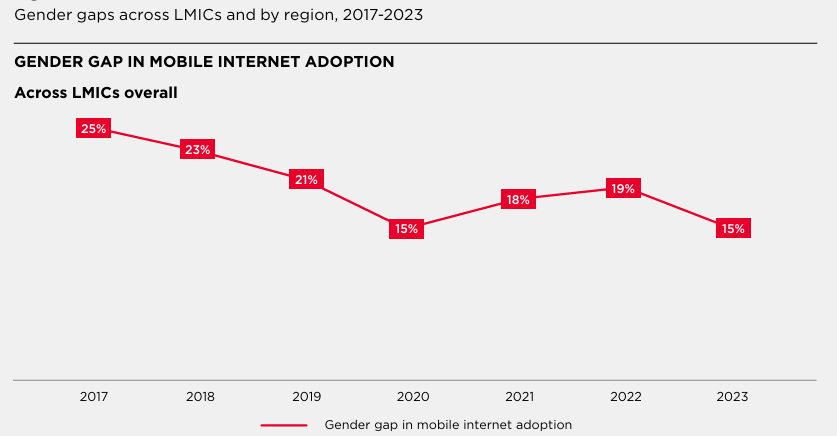
Source: GSMA Mobile Gender Gap Report 2024
It is extremely crucial hence that the discourse expands to more nuanced and critical barriers that are often hard to measure and nevertheless result in inequalities for women in the workplace.
Situating Location and Time within gig work platforms
When looking at barriers to employment for women, location and time have always emerged as constraints historically and online gig work platforms are no exceptions. Yet with algorithmic gig work it has taken a new form. Platform-based gig work has been hailed as a new era of accessible and flexible work opportunities yet who gets the dividends of this highly adopted form of business remains a critical question. Women engaged in algorithmic gig work face three major constraints related to location and time: concerns around respectability, time poverty, and personal safety.
II.A. Historical division of public spaces and respectability
The restrictions on women being alone in urban public space have a long history. Elizabeth Wilson discusses the moral panic surrounding women’s increased visibility on the city streets in Victorian London. The term “public woman” being an old euphemism for a sex worker (Wilson, 1992) (Kern, 2021). In this sense, location can be a more metaphorical allegory to the division of spaces within cities and how this division has perpetuated inequalities.
(Phadke et al., 2011) argue that women’s access to public spaces is often conditional, requiring them to demonstrate “respectability” and a legitimate purpose. In their ethnographic study of Mumbai, they observe that women frequently engage in acts of self-surveillance, such as carrying large bags or appearing preoccupied, to legitimize their presence in public spaces. This “manufacturing of respectability” underscores the societal expectation that women must justify their right to be in public without a prescribed purpose.
(Fairwork, 2023) conducted a research in 38 Fairwork Country teams, finding that there is a clear gender segregation between platforms that operate within public spaces (like transport services – dominated by men) and private spaces (like domestic, beauty and care work – dominated by women). While such gender divisions are historically and culturally rooted, they continue to be perpetuated due to consumer preference for certain tasks to be conducted by specific genders. Gig work especially delivery gig work hence falls at this precarious junction between what could be called legitimate yet involves travelling and running around constantly in public which is not respectable enough for a woman. This is reflected in the data as well with Swiggy having just 1,000 women in its fleet of 2,20,000 workers (ET Retail, 2021). Only 0.5 per cent of Zomato’s delivery partners are women (Chakravarti, 2021). Urban Company, which has built its business on traditional gender roles and involves women working in private spaces, has 32,000 active service partners, of which a third are women (Faleiro, 2023).
II. B. Care work
Time poverty and its impact on female employment has been a key theme in policy and economic research ever since the first Time Use Survey was conducted in India in 2019, which pointed towards the unequal burden of unpaid domestic responsibilities that are coerced upon women. The Time Use Survey 2024 finds that women aged 15-59 years are 20% per cent more likely to participate in caregiving for their household members than men. Also, women spent 140 minutes in a day doing caregiving activities when compared to men who spent just 74 minutes, which makes it almost double the amount of time for women. The case of unpaid domestic services is even worse with 81.5% of women and girls of age 6 and above engaged in unpaid domestic services while only 27.1% men are doing the same (Ministry of Statistics & Programme Implementation, 2024). This clearly shows that all the caregiving and domestic services on men’s part are also performed by women.
Situating this within the broader context of gig work there are two major facets that arise. First, while the gig economy is often praised for allowing workers to choose their own hours, this flexibility is unevenly distributed. First, while the gig economy is often praised for allowing workers to choose their own hours, this flexibility is unevenly distributed. Given the “flexible” nature of gig work, which particularly incentivizes deliveries between 12 a.m. and 6 a.m., women are indirectly affected, even if they are not directly engaged in such work. These women often support male household members – husbands, sons, or fathers – who are part of the gig economy. As a result, they must shoulder the burden of this erratic schedule. They work extra hard on unpaid domestic tasks to accommodate this so-called “flexibility.” Ironically, this makes their own routines far less flexible. Resulting in greater time poverty for women at home, making their schedules even more rigid and burdensome. Care and domestic work that is done at home, creates the context and support for other forms of work done outside the home (Arora et al., 2023). Second, women who seek to enter the gig economy often find that they are not truly offered flexible jobs at all. Their daily routines are already dictated by care work, child-rearing, and other domestic duties, responsibilities that are non-negotiable and continuous in most households. As a result, the “freedom” to choose working hours becomes largely illusory; their choices are constrained not by the nature of gig work itself, but by the structural inequalities that shape gender roles within the home.
Arlie Hochschild in her seminal work, “Second Shift”, argues that women bear the brunt of what she calls a ”stalled revolution,” one that got wives out of the home and into the first shift of paid employment but resulted in surprisingly meagre change during the domestic second shift. The wife typically is still the primary parent and in most marriages, the woman’s paid work is still considered a mere job, in contrast to the man’s career (Hochschild & Machung, 1989).
II.C Safety
Safety is a constraint where location and time intersect. In a study by Chaney et al., 2023, 571 participants were shown images from their own college campus depicting different lighting (daytime, night-time), and entrapment levels (high, low; i.e., able to easily escape if needed, with high entrapment being difficult and low being easy). For the most part, male respondents tended to identify paths and walkways, whereas female respondents were more likely to point out areas outside the path, such as bushes or dark areas (Chaney et al., 2023). This was especially true at night and in high entrapment areas indicating how perception of time and location vary from women to men even in places that they are used to.
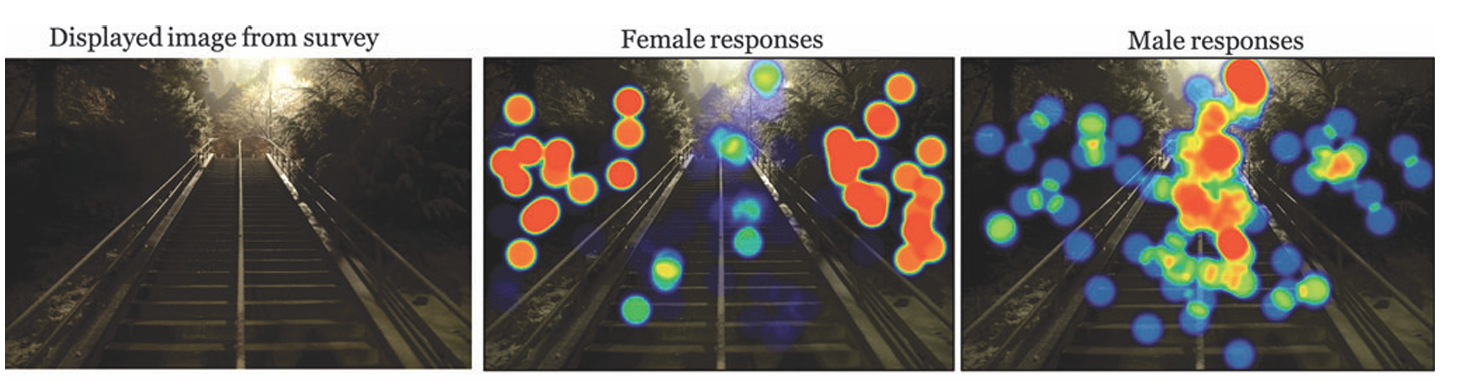 Comparison example: High entrapment night-time at BYU
Source: (Chaney et al., 2023)
Things that are considered subtle like sunset conditions increase perceptions of danger and pose greater risk for women who commute or exercise at night (Boomsma and Steg, 2014). Fear associated with night-time, or poorly lit, commuting has been shown to negatively impact female students’ physical, emotional, and social health (Burdette and Needham, 2012; Larson et al., 2013; Park and Garcia, 2020).
Parikh (2017) details how the outsourced call centre industry, heralded as the beacon of modernity during the early 2000s, had to deal with a similar conundrum. Here as well women were at the crosshairs of narratives that demonize them as ‘bad women’ for being out on the street at night, while working in industries that specifically seek women willing to work in night shifts. The study explains how the anxiety of families shaped women’s mobility, where they often left for home immediately after their shift to assert that they were not ‘loitering,’ or engaged in unproductive activities after work (at night). Women were concerned about being considered frivolous, internalizing its association with a lack of respectability.
Combined with concerns of sexual safety are the complex and layered notions of who is considered as a bad woman, “loitering” at night being a major determinant at that. Sexual violence is often legitimized when against so called “bad women” hence, increase the anxieties of women working at night. Delivery gig work in India is mostly operationalized through storage facilities called “dark stores” which are built exclusively for online order fulfilment. As and when the delivery partners are assigned an order they come, pick up the goods and deliver it door to door. As the name itself suggests, this is a particularly scary situation for women where both location and time safety intersect. Light has been proven to be a major factor in women’s perception of safety. The way light interacts with surfaces and colours in the built environment is crucial in affecting how people perceive brightness and safety. Together with the social context of a space, these factors strongly correlate to feelings of safety and comfort (Arup, 2024).
Platform Design and Policies
As discussed in the previous sections, time and location pose the biggest vulnerabilities for women in these contexts and although platforms differ in their service offerings their policies for gig workers remain more or less the same. Globally, workers with child- or elderly-caregiving responsibilities, and those who are minorities because of their gender identity (as well as race, caste or ethnicity) turn to platform work because it has comparatively lower barriers to entry. As such, platform work attracts workers who are already precarious and vulnerable. In this setting, while platforms can offer much-needed opportunities to their workers, they are, undeniably, also positioned to exploit those workers who are disproportionately dependent on them (Fairwork, 2023).
Urban Company (Formerly Urban Clap)
Urban Company is an online platform that enables consumers to order services, including skincare, hair grooming, massage therapy, cleaning, pest control, plumbing, carpentry, appliance servicing and repair, painting at the convenience of their own home (Urban Company, n.d.).
Insta Maids
Although the data seems to strengthen women’s role in the emerging gig work spaces, Urban Company’s whole business model is rooted in making use of traditional gender roles to create business opportunities. This was particularly evident when they recently launched their newest service offering “Insta Maids,” which aimed to connect customers with domestic help. The name sparked immediate backlash on social media for being not only tone-deaf but also deeply sexist and casteist. The term “maid” is historically loaded, as it reduces women to subservient roles tied to household labour, reinforcing patriarchal norms where domestic work is viewed as less valuable and inherently feminine. Moreover, using the prefix “Insta” commodifies this labour further, implying on-demand servitude and erasing the dignity and skill involved in such work. It also subtly reinforces the notion that domestic work is something to be consumed conveniently, rather than respected as labour. Although UrbanCompany in its statement clarifies that “”Insta Maids” made perfect sense from a marketing perspective”, their choice of branding reflects a deeper attitude of the organization, towards the gendered nature of labour. Due to the timely backlash on social media, Urban Company eventually rebranded the service as “Insta Help”.
Location and Time
Situating Urban Company within the larger theme of this paper, it is one of the key platforms where the vulnerabilities of location matching and time scheduling for women is most pronounced. These challenges stem primarily from two factors: first, the nature of the work requires women to physically enter clients’ homes to perform services, unlike delivery platforms where mobility is limited to pickup and drop-off; second, although jobs are claimed to be confined to a 10-kilometer radius from the worker’s residence by Urban Company, this boundary is often breached in practice, forcing workers to undertake burdensome and expensive commutes between assignments (Faleiro, 2023).
In an interview conducted by “the rest of the world” Patricia Kumar, a professional associated with UC shares, “It was exhausting – and frightening – to enter the homes of strangers.” Once, she had arrived to massage a female client, only to find herself being verbally coerced by the woman’s “husband” to give him a massage instead. It appeared to be a setup: The “husband” claimed that his “wife” was in the bathroom, and that she could just go ahead and massage him instead. She declined, and left immediately.”
Urban Company mentions on its website, “Use the app to tell us when and where you want to work. We’ll line up jobs for you in your desired time slots, so you never have to worry about scheduling.” Yet the Company rolled out some new policies in June 2024 which was described as “horrific” and akin to “slavery-like situations” by the Gig and Platform Services Workers Union (GIPSWU), part of the Indian Federation of App-based Transport Workers (IFAT). GIPSWU condemned the policies and went on strike to protest in front of the UC Bangalore office (Business & Human Rights Resource Centre, 2024). The new set of policies stated that the workers were now being required to work around 13 hours on weekends without any additional incentives although they were promised flexible working hours of up to 10 hours a day. In addition to this, the new policies mandate a minimum rating of 4.8 along with only two cancellations per worker per month and they are at the risk of losing their employment if there are more cancellations. Among the most contentious features of the new set of policies is the ‘auto-assign’ system, which removes the worker’s ability to accept or decline a booking based on factors such as location, order value, or personal emergencies. GIPSWU leader shared during the protest that “Women are the most affected since they join the platform after the promises of duties within a 5-kilometer radius, but now they are being sent far away. They need to spend more on transportation charges for commuting to work.”7 Even workers who want to stick to this schedule may be unable to. A job that lasts only 45 minutes can take hours longer because of the travel to and from a client’s home. Workers aren’t compensated for this extra time, and neither are their travel costs subsidized.8 This reinforces the central argument of the paper: that the algorithmic gig economy, in its current form, not only fails to accommodate the specific vulnerabilities of women workers, but actively exacerbates them through opaque, gender-insensitive policies.
In such a context, the bare minimum an organization should provide is robust and enforceable safety measures, especially considering the solitary, mobile, and often intimate nature of the services these workers are expected to perform. Yet the reality is grim. Fairwork mentions that Urban Company has policies and mechanisms in place to protect its workers from task-specific risks, including safety training and an SOS button. “Workers are also provided with safety equipment such as harnesses and gloves, at no additional cost.” Aside from the SOS button, which is a reactive tool rather than a preventive safeguard, there is little evidence in the company’s public documentation of any targeted policies or mechanisms specifically designed to address concerns of sexual harassment, unsafe work environments in private homes, or the need for support systems in emergency situations. It took the company 7 years since its launch to update safety measures to include an SOS button for women workers on the app, which would connect workers to a company helpline in case of an emergency. The SOS button was introduced only after significant protests and widespread media criticism. In response to the backlash, Urban Company published a Medium blog outlining a “12-point program” aimed at “improving partner earnings and livelihood” (UrbanCompany Blogger, 2021).
Given that the core nature of the job involves women entering private homes, often alone and in unfamiliar environments, the absence of explicit, gender-sensitive safety measures is not just an oversight but indicative of a deeper structural blind spot. It reveals a fundamental disconnect between platform design and the lived experiences of its predominantly female workforce. The lack of anticipatory safeguards against gender-based risks suggests that those designing these systems either did not fully consider or chose not to prioritize the specific vulnerabilities women face in such contexts. Not considering and prioritizing is harmful enough but wilful ignorance and even suing its workers for protesting against gender unequal practices is a grave problem (Chandran, 2021).
Direct threats of sexual harassment in gig workers’ environments represent only the surface of the deeper, structural issues embedded in location-based matching systems. A more nuanced feminist analysis of “location” reveals that for many women, decisions around accepting or rejecting a job are shaped by subjective and legitimate concerns around safety, mobility, and social norms. When platforms impose rigid cancellation limits, without accounting for a worker’s perceived risk or discomfort, they create systems that not only ignore these lived realities, but actively endanger women by penalizing protective decisions.
This inflexibility fails to engage with the long-standing gendered dynamics of public space, where women have historically been excluded or discouraged from working outside the home due to fears of violence, social stigma, or lack of safe transit. As the discourse on the “future of work” increasingly turns to the gig economy as a flexible solution to labour market demands, it is critical to recognize that sustainability in gig work cannot be achieved without reimagining platform design in a way that centres the safety, agency, and social positioning of women. Without such an intersectional approach, these systems risk reproducing and deepening existing inequalities under the guise of innovation. Merely offering women spaces where you can maximize your profit by exploiting traditional gender roles doesn’t count as women empowerment.
Despite the apparent lack of gender sensitivity in platform policies and design, there is also a need to recognize recent efforts in addressing domestic violence by Urban Company. Urban Company’s Project Nidar claims to help the company’s active service professionals who are currently facing or have faced domestic violence and abuse. The company will provide counselling, legal assistance and emergency lodging support. Apart from this, the company will provide medical support, beyond the already existing INR 1 lakh insurance cover, and financial aid of up to INR 50,000 to service partners seeking help (Urban Company, 2024). By integrating domestic violence support directly into their platform infrastructure, the initiative recognizes that women’s economic participation in the service economy cannot be divorced from broader contexts of patriarchal violence and control. However, the initiative’s transformative potential hinges on whether it genuinely redistributes power and agency to women workers or merely manages the symptoms of structural inequality while preserving existing labor hierarchies.
Other platforms
Unlike UrbanCompany which has traditionally gender based job roles like beautician, massage therapist etc., Swiggy, Zomato etc. are focused on delivery pickup and drop based and hence employ fewer numbers of women. These platforms are comparatively more flexible in terms of time and location because the workers can start their shift whenever they want to and there are also options for part-time shifts where most college students work, logging to the app after college to deliver orders. This flexibility should ideally enable more women to take up these jobs given their care based duties and resulting time poverty. Yet there are very few women employed in this sector. This conundrum requires looking deeper and understanding that the webs of an unequal patriarchal structure are interconnected and layered. Although due to the time based constraints this seems ideal, there are additional constraints put on women when it comes to public spaces and work as discussed in section III. Most delivery workers use motorcycles or scooters to deliver orders. Women on motorcycles is a rare sight in India and the act of women riding motorcycles for door-to-door delivery challenges deeply entrenched ideas on propriety and lack of safety infrastructure held strongly by families and communities. Therefore the double burden of time and location constraints put on women restrict choice and options of jobs for women even in the gig work industry which is touted to be more flexible and accessible.
But this doesn’t mean that the barriers to entry and male-centric platform in delivery gig work should not be altered. According to the Fairwork Scoring System, platforms like Swiggy, Bigbasket, Zepto and Zomato have SOS buttons as of 2024. Other than this there are barely any safeguards for gendered inequalities in any of these apps. The Scoring system mentions that certain apps like Swiggy, Bigbasket, Zomato that workers have the option to contact human representatives for problems and appeal disciplinary actions. Workers have access to the platform’s application even after deactivation and that workers are not penalised for raising concerns. Except the SOS buttons Zepto doesn’t seem to have any of these safeguards in place according to Fairwork.
Way forward
Where do gig workers in the platform economy fall in the Indian legal framework?
A central debate that has dominated labour law since its inception has been whether a category of workers can be classified as independent contractors or as workers in need of protection under traditional labour law (Chokshi & Madhulika T, 2025). In 2021, the Indian Federation of App-Based Transport Workers (IFAT) filed a petition in the Supreme Court challenging the contracts used by companies like Ola, Uber, Swiggy, and Zomato, which classify gig workers as ‘partners’ rather than ‘employees’. The organization alleged that by designating gig workers as ‘partners’ instead of ’employees,’ these companies evade their responsibility to provide social security benefits, a practice IFAT claims violates constitutional provisions under Articles 14 (Right to Equality), 21 (Right to Life and Personal Liberty), and 23 (Prohibition of Forced Labour and Exploitation) (Sadashiv K, 2024).
Currently the Indian legal framework does not consider gig workers as “employees”. The Code on Social Security, 2020, brought gig workers within the purview of the law for the first time. The Code on Social Security Bill 2019 empowered the central government to set up social security funds for unorganised workers, gig workers and platform workers and the 2020 Bill states that the central government will set up such a fund. The Code provides for framing of social security measures for gig workers and platform workers on life and disability cover, accident insurance, health and maternity benefits, old age protection, etc (Press Information Bureau , 2024). The 2020 Bill also makes provisions for registration of all three categories of workers – unorganised workers, gig workers and platform workers. Chapter I, Section 2(35) of the Code on Social Security, 2020 defines a gig worker as “a person who participates in a work arrangement and earns from such activities outside of a traditional employer–employee relationship.” The definition, however, lacks clarity as to who exactly a gig worker is, but it clearly separates the gig workers from regular employees and other non-employee classes of workers. Section 2(61) of the code defines a platform worker ‘‘as someone engaged in or undertaking platform work,’’ which hardly provides any operational element in the definition. All platform workers are likely to be gig workers since platform workers are paid on a task basis, whereas all gig workers may not be platform workers (M G & M, 2022). Although this is a great first step, it stops short of granting gig and platform workers the same rights as traditional employees.
Let’s look at five key laws that could have benefit female gig workers if recognized as employees by the law:
Sexual Harassment of Women at Workplace (Prevention, Prohibition and Redressal) Act, 2013 (POSH Act)
If gig workers were formally recognized as employees, the POSH Act could offer them meaningful safeguards against sexual harassment. Although the Act explicitly extends protection to harassment by clients, customers, and third-party vendors during the course of work, platform companies continue to benefit from the legal ambiguity around worker classification, thereby evading responsibility for ensuring safe working conditions. If a client sexually harasses an employee or another client, the victim can file a complaint under the POSH Act, and the organization is responsible for investigating and taking corrective action (Sexual Harassment Law Compliance, 2022).
The Code on Wages, 2019
It ensures minimum wages, timely payment, and equal remuneration for men and women. But gig work platforms argue workers are self-employed and not covered under wage laws, allowing them to pay per task without meeting minimum wage thresholds.
The Code on Social Security, 2020
The code consolidated laws on Employee Provident Fund (EPF), Employees’ State Insurance (ESI), maternity benefits, gratuity, and more. Gig workers, as mentioned above, were recognized for the first time within this code but since they are classified as “platform workers,” a separate category with limited and non-binding social protections, the benefits aren’t directly extended to them. There are no mandatory contributions from platforms towards pension, insurance, or maternity leave.
The Industrial Disputes Act, 1947
Companies have been reported to deactivate workers’ accounts without explanation or due process, often relying on opaque algorithmic decisions (Kalia, 2023; Tan & Gong, 2024). Alacovska et al. (2024) conceptualize the subjective experiences and emotional responses to these widely perceived abusive, opaque, and uncertainty-inducing algorithmic management practices as ‘algorithmic paranoia. This act protects employees from unfair dismissal, and requires notice and compensation for termination. This would be especially helpful for female workers who might be afraid to raise concerns to the platform out of a fear of their accounts getting deactivated without any redressal or recourse.
The Equal Remuneration Act, 1976 (now merged into Code on Wages)
The Equal Remuneration Act, now subsumed under the Code on Wages, 2019, mandates equal pay for equal work and prohibits gender-based wage discrimination. The wage registry requirements (Form D) that mandate gender-disaggregated pay data for traditional employers do not apply to gig platforms, eliminating transparency mechanisms that could expose discrimination. While traditional employers face inspection by Labour Enforcement Officers and complaints procedures, gig platforms operate in a regulatory vacuum where female workers have no institutional recourse for wage discrimination.
Where do we go from here?
Arora et al. (2023) put forth a framework to work with when it comes to policy redesign and the world of work in relation to women. They specify two key sites where critical policy needs to happen – work-place and work-form. The first is concerned with the nature of the labour market and the affordances of labour design that encourage or discourage women workers. The second revolves around the nature of work and its valuation in the market and in society.
Work-place considerations can range from the physical structure of the factory or shop floor to the laws and provisions that secure workers’ rights in various sectors. In the digital era, this would include the design of platforms for gig work as also the education and sensitization of workers and employers around the evolving nature of rights and responsibilities in the new economy. Situating work-place considerations within gig work in India, the work-place considerations become particularly critical given the algorithmic mediation of labour allocation and management in digital platforms. Similar to ESG audits, although a fairly recent phenomenon, there could be mandatory algorithmic fairness audits in companies using algorithmic platforms. Fairwork in its ratings mention that Swiggy and Zomato conducted an external independent audit of its work allocation algorithm to check it for instances of bias. (Fairwork). The ESG framework in India, which has already been institutionalized through SEBI’s Business Responsibility and Sustainability Reporting (BRSR) guidelines for listed companies, provides a precedent for how systematic auditing can drive corporate accountability. In the gig economy context, such algorithmic audits would serve a dual purpose: ensuring fair work allocation while addressing the gendered dimensions of platform labour that often take advantage of the precarious conditions in which women workers seek work through biased recommendation systems, opaque performance metrics, and discriminatory customer rating mechanisms. This would necessitate platforms to not only conduct regular third-party algorithmic audits but also implement transparent grievance redressal mechanisms, publish algorithmic decision-making criteria, and establish clear channels for workers to challenge automated decisions that affect their livelihoods. Publishing algorithmic decision-making criteria can also pave the way for increased academic research on this front, leading to a deeper understanding of how platform structures reproduce social inequalities and enabling the development of more equitable and inclusive policy interventions.
Within the audits a key aspect should be employing human representatives in algorithmic platforms. There is a growing concern over AI replacing humans in the workforce but a strong policy framework can ensure that workers are not replaced by AI but moved to new and emerging industries. In this particular case complete automation in algorithmic matching is leading to unfair treatment of workers especially invisibilizing the gendered nuances. Including human representatives who can act as checks and balances ensuring that the workers can reach out to them for grievance redressal, safety recourses etc. will lead to better treatment of workers and also ensure jobs in a sector that is emerging and is in dire need of context-specific solutions that only humans can provide. This will also strengthen concerns raised by workers in various protests including having access to the platform’s application even after deactivation and that workers are not penalised for raising concerns.
Another key platform design change that needs to happen is more transparency. With respect to ride hailing platforms, Pallavi writes, complete information about the rides become all the more relevant for women drivers, who fear unfamiliar locations and routes as expressed by female drivers. All the drivers in her fieldwork shared that they could see the passengers’ photographs and even the names were revealed only after accepting the ride. However, passengers can view the drivers’ photographs and names immediately after the ride is allotted to them, making transparency a one-sided process in the platform economy(Arora et al., 2023).
Work-form considerations might include a reimagination of both work and worker when we talk about a feminist future of work. Work is increasingly being done in places that have not been traditionally considered locations of productive labour, such as the home, which then must be counted within the economy. This highlights two broad and intersecting themes: the economic recognition of care work, and the commercialization and delegation of care responsibilities through algorithmic gig platforms like Urban Company.
Hochschild offers a compelling framework for understanding the evolving dynamics of gig-based domestic service platforms. She argues that American capitalism over time embraced empowerment and side-tracked care. In the absence of a countermovement, care became a hand-me-down job – men hand it to women, high-income women hand it to low-income women (Hochschild & Machung, 1989). A pattern that easily resembles how care and domestic service duties are being handed down to gig workers through emerging platforms like Insta Help (formerly Insta Maid). This stratified delegation of care reflects broader socio-economic hierarchies, wherein domestic labour is systematically externalized to more precariously positioned individuals who are “easy to access”. The emergence of digital platforms such as Insta Help (formerly Insta Maid) reproduces this pattern in technologically mediated form. Though framed in discourses of flexibility and economic inclusion, such platforms often replicate historical inequities in new algorithmic forms, further entrenching care work as undervalued and invisibilized labour.
These platforms are capitalizing on the gendered nature of care work, often operating in regulatory grey zones with little oversight from governments or academic scrutiny. As a result, the future of work, when viewed through a gendered lens, appears increasingly exploitative where gig platforms have uncovered a gold mine in the undervalued and largely invisible care labour market.
Start-ups in this sector are aggressively capitalizing on this exploitation, even resorting to insensitive and out-of-touch marketing campaigns that trivialize their workers, reflecting a deep disconnect from the lived realities of labour on the ground. Yes Madam, an emerging salon and technology company is a great example. In the Indian context, “Madam” is a term often used by domestic and service workers to address upper-class, often upper-caste, women, reinforcing a deeply entrenched hierarchy rooted in caste and class. The phrase “Yes Madam” evokes a legacy of servitude, normalizing the expectation of unquestioning obedience and submission, especially from those in marginalized positions. Though seemingly a nod to female authority, it actually upholds patriarchal and casteist norms by commodifying deference and embedding inequality into everyday service interactions. The company also faced widespread backlash for a controversial marketing stunt in which it falsely claimed to have laid off employees after a workplace stress survey only to later reveal it was a publicity campaign for its mental health initiative Happy 2 Heal exposing the deep rooted normalization of trivializing mental health and job insecurity. Taken together, both the campaign and the name reflect how start-ups can unwittingly reproduce oppressive social structures in their pursuit of virality and brand visibility.
This along with the clear omissions of safety recourses for women in all of the platforms studied in this paper point to a broader fault line in the platform economy, where technological convenience and scale often come at the expense of worker dignity, safety, and equity. Combining both work-place and work-form policy redesigning, to facilitate greater female participation in these platforms is essential to address both infrastructural and cultural barriers. Investing in gender-sensitive urban planning, such as providing safe and accessible public transport, well-lit streets, and public amenities, can help create an environment where women feel secure and empowered to engage in such work. Simultaneously, challenging and dismantling societal norms that restrict women’s mobility and autonomy is crucial. This involves promoting narratives that celebrate women’s agency and challenging the stigmatization of women who step outside traditional gender roles.
But it doesn’t stop at increasing female participation, it is crucial to ensure that the women already engaged in this work are treated with equality, dignity, and fairness. During the boom of the outsourced call centre industry, national policies were drafted that recommended companies to provide transportation for night-shift workers to ensure women’s sexual safety (Parikh, 2017). Certain states like Maharashtra, went a step further and required that companies do so. In conclusion, integrating a feminist critique into the analysis of women’s participation in gig economy platforms reveals the complex interplay between location and time. By addressing these intersecting factors combined with strengthened legal protections as discussed above, we can work towards creating a more inclusive and equitable gig economy that recognizes and supports women’s rights to participate fully and freely.
Edited by: Adrita Choudhury


