The recent decision of the Cabinet Committee on Political Affairs (CCPA) to include caste enumeration is monumental (The Indian Express, 2025). It has been unanimously welcomed as a major step towards a fuller understanding of caste based inequalities to better formulate policies. But the 16th decennial census is also loaded with aspects that make it a different, and possibly unique, census. The stretching delay and its implications on welfare, talk of a first digital census, and the link between census implementation and National Population Register (NPR), are just some of the numerous strands linked to the next census. They are also openings looking over the historical passage in which census, state, and democracy have webbed together an intricate and interesting relationship.The focus here is to think about specific factors which could have led to such unique facets of the upcoming census. For instance, what forces of democracy lie behind the apparent consensus on caste enumeration? What could be the direct and indirect costs of the census delay? Beyond costs, does the delay point to other tendencies of the state and census’ relationship? What potential issues come along with declaration of digitisation of the upcoming census ? How do we understand other recent global examples around interventions of governments ? This article attempts to look at such questions in light of the 16th decennial census, which reveals emerging contours the upcoming census would be navigating.
Caste, Aggregation, and Factual Territory: A Dynamic Process
The political sphere in India has witnessed a substantial back and forth on the issue of the caste census as of late. During NDA’s first tenure, in 2018, the then Home Minister Rajnath Singh had come out in support of inclusion of caste as a category (The Wire, 2022). In 2021, the Minister of State for Home Affairs, Nityanand Rai, mentioned in the Lok Sabha that the government had decided to not include enumeration of categories other than SCs and STs as a “matter of policy” (India Today, 2025). The same year, in an affidavit, a tentativeness towards it was displayed, calling the process “administratively difficult and cumbersome” (India Today, 2025). Experts at that time had attempted to find political incentives underlying the changing stance of the government. For instance, at a conference, the upcoming UP election¹ was ascribed as a possible political incentive. The possibility of the ‘Hindu vote’ being aided by ambiguity of exact numbers was also brought up (The Wire, 2022), pointing to possible political incentives nudging such decisions. But why has it been absent in the last 90 years?
The last time caste was included as a category in the national census was in 1931.² Historians argue that counting of caste during the British period sharpened polarisation within society on caste lines, which led to Nationalists opposing it as ‘divisive tools of imperialism’ (Dirks, 1992; Cohn, 1987; Appadurai, 1993; Bayly, 1999: 244). Early policy makers, influenced by this line of thought, were therefore keen on removal of caste from census, to sever its historical role in the colonial period. However there is also evidence to the effect that including caste also brought to the fore inequalities persisting in that period (Singh, 2022). Inclusion of caste enumeration has been a politically contested issue with ideological factors behind its historical exclusion. Even so, it is worth evaluating the fresh consensus across political lines, in the light of pressure from state governments. The Bihar, Tamil Nadu, Telangana, Odisha, and state governments have previously passed resolutions in their state assemblies for a Caste census. “This House considers that caste-based population census is essential to formulate policies in order to ensure equal rights and equal opportunities in education, economy and employment to every citizen of India” (The Wire, 2024), the Tamil Nadu state government’s resolution read. The opposition, too, has been vocal in their demands for a caste census.
Census and Democracy
The centre’s decision to finally include caste enumeration, and assertion of state governments for the same, brings forward a more foundational point about the nature of census within democracy. Looking at a historical, state-backed quantification process like the census from the point of view of ‘Informational basis of Judgment in Justice’(IBIJ) (Sen, 1990) can be useful in understanding this connection. The central piece of this basis, according to Amartya Sen, is creation of a ‘factual territory’—a sphere, composed of facts, would form the very basis of all justice and fairness considerations of society (Sen, 1990). It is apparent that the census, being the cornerstone of data based welfare policies, plays a decisive role in the formation of this territory within modern democracies. Building on IBIJ, Robert Salais (2022) highlights two key yardsticks on which a quantification process taking place within democracy must be analysed. The first is about statistical correctness and rigour, the other is justice. To make an attempt towards it, quantification must be “achieved between the involved persons and actors on the chosen principles of justice (fairness)”. The inclusion of caste enumeration is probably the culmination of a long negotiation between different actors on what would constitute the factual territory.
Transgender and Pasmanda Muslim Categories: Assertion and Factual Territory
The historic inclusion of ‘transgender’ as a category of Household Heads in the upcoming census (India Today, 2020) is another example of a negotiation between concerned actors on what the factual territory must look like. However, it is important to also see developments on these “chosen principles” as dynamic and continuous. The place of Pasmanda Muslims in caste enumeration is a case in point. So far, all censuses have included Muslims as a single bloc; however, there has been a growing demand for their inclusion as a separate category within the OBC bloc. Some prominent leaders of the community have also called for their inclusion among SCs (The Indian Express, 2025).
The contrasting position of Pasmanda muslims and transgenders as categories in enumeration is interesting. It points to the link between assertion of a community in the public sphere and categorisation. How much a community has asserted itself in the public sphere could bear on its representation in the ‘factual territory’ (Sen 1990).³ It also reveals the evolving nature of the factual sphere. Assertion of new identities can change how data about them is aggregated.
Welfare Implications of a Delayed Census
Despite a broad consensus on Caste enumeration, issues around uncertainty of timeline persist. Tamil Nadu chief minister M. K. Stalin, while welcoming the move, stated that key questions on the timeline for the 16th census remain unanswered (New Indian Express, 2025). A prolonged delay in the decennial census, initially set to be conducted in 2021, has had large implications for welfare schemes.⁴
A major casualty of the prolonged delay have been the exclusions in Public Distribution System (PDS). Under the National Food Security Act (NFSA), the PDS must cover 75% of the population in rural areas and 50% in urban areas, which comes to 67% of the total Population (NFSA, 2013). Figures for both these are still driven by 2011 census numbers. The Indian National Congress (INC), in 2024, claimed that 14 crore people have been deprived of the benefits under the National Food Security Act (NFSA) because of the delay (The Hindu Bureau, 2024). According to estimates put forward by Dreze and Khera (2020), around 122 million people were excluded from PDS (IndiaSpends, 2020). A state wise breakdown of this estimation was also provided using population projections constructed from Birth and Death state specific rates updated till 2016.
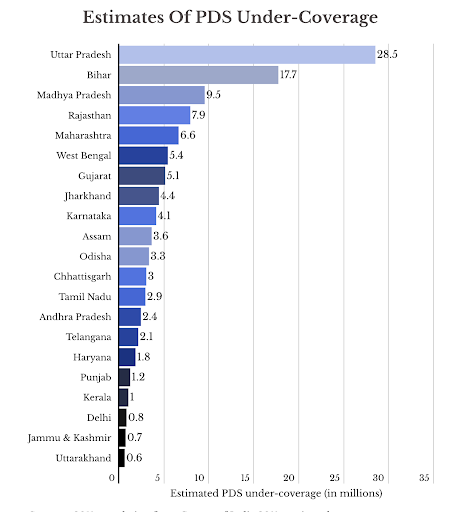
Source: IndiaSpends report based on estimates put forward by Jean Dreze and Ritika Khera.
Uttar Pradesh and Bihar constitute more than 35% of the estimated excluded people. At least 18 states would be having an undercoverage of more than 1 million people, with seven of these states having an undercoverage of more than 5 million, according to the estimates. Dreze and Khera also point out stagnation of the number of ration-card holders. Lack of fresh numbers hinders the State governments’ capacity to issue fresh Ration Cards. They recounted Jharkhand’s example to claim that around 7,00,000 applications for ration cards are pending there alone (The Hindu, 2020). Clearly, the delay is causing exclusion errors from PDS en masse. But effects may not just be limited to PDS.⁵
Census and Other Household Datasets: Issues of Frame and Welfare
Anjali Radhkar, head of centre for study of social inclusion, Gokhale Institute of Politics and Economics, cautioned that, “If India continues to rely on the outdated 2011 census figures, the gap in current demographic understanding will grow wider, potentially affecting everything—from urban planning to social security measures” (Nambiar, 2025). The reason behind this concerned sentiment is the critical linkage census data shares with other datasets used for estimating different kinds of welfare measures and policy. All household level datasets derive their sampling frame, i.e., the set from which a random sample is drawn, from the 2011 census. In the absence of the 16th census, the frame being used is therefore an outdated one. A delayed census compromises the quality and credibility of all household level sample datasets. Prominent ones falling in this category include the National Family Health Survey (NFHS). The NFHS-5 sample is a stratified two-stage sample. The 2011 census served as the sampling frame for the selection of Primary Sampling Unit⁶ (Ministry of Health and Family Welfare, GOI, 2021). Data from this is used for determining people to be targeted under National Nutrition Mission (Poshan Abhiyaan) (Ministry of Women and Child Development, GOI, 2022).
The Household Consumer Expenditure Survey is used for the estimation basket of consumer goods and services (which is used in the estimation of poverty line). Consumer Price Indices—one of the key indicators of inflation—are also calculated from this data. The latest round released in 2024 used census 2011 as a sampling frame for the rural sector (MoSPI, 2024). Which would seriously comprise the validity of inflation estimates and poverty estimates, especially if broken down for the rural sector. The same issue on rural sample frame persists with Annual Survey of Unincorporated Sector Enterprises (ASUSE) which support schemes like PM SVANidhi for street vendors (MoSPI, 2024). Sample Registration System, a national demographic survey, also uses the census data for enumeration blocks (Palitath, 2022).
Clearly, crucial estimations depend on census data. A delay impedes the specific welfare work dependent on each of these estimations. A compromise on quality of other crucial datasets also dents the high ceiling of credibility still reserved for government data. Additionally any-post covid analysis of welfare schemes must target migrant workers. Hopes are pinged on the 16th census for this too, as it would be the key database to give us a comprehensive understanding of the situation of migrant workers post-covid.⁷
A Digital Census amidst Digital Divide: Implications for Method and Justice
The next census has been set up to be the first digital census conducted by India. The changed method would render the notion of scores of government officials going around with heaps of papers a point of nostalgia. Instead, we might see enumerators conducting the survey on an app. It could even be us filling up the survey ourselves. The option of ‘self-enumeration’ by registering would be available. “A mobile app will be used in census 2021. It will be a transformation from paper census to a digital census,” (Hindustan Times, 2019) Home Minister, Amit Shah had remarked in 2019 . Vivek Joshi, the then Registrar General, had cited ease of availability of data from digitisation. “The results will be available almost immediately” he had remarked. Data collected digitally is therefore also more likely to be disseminated much quicker.
Atanu Biswas , Professor at ISI, welcomed the move as an efficient and inevitable one. He cited Austria’s example to show a digitised census, which entails a switch to a register based census, massively reduces the cost of conducting the census exercise (Biswas, 2019). Undoubtedly, digitisation creates alleys of efficiency hitherto closed. It opens up the possibility of much quicker availability of data and cost-effectiveness. But how prepared are we to go down that route?
An app-based or a portal based enumeration assumes access to smartphones and internet connections. According to a 2022 Oxfam India Inequality Report, around 40 per cent of mobile subscribers did not own smartphones. There is a serious lack of access to digital services, with 70 per cent of the population having poor or no connectivity to digital services. A gendered digital gap also persists; 30% less women owned phones than men (Oxfam India, 2022).
The magnitude of this divergence casts a shadow over the reach of the census. Even if, effectively, it means access must only belong to all enumerators, for it be to implemented, the large number of enumerators needed for the exercise implies that the digital divide is likely to play a role in enactment of the census on ground. Should one choose to fill it out themselves, we would not need an enumerator to conduct the survey. Doing away with the enumerator would mean that a respondent is unable to clarify any doubts they might have over the definition of categories. For example, the perception of a household could vary amongst people, often differing from how the survey instrument might seek to record it. If self-enumeration is introduced, the online form should necessarily contain definitions, explanations, and examples as a first step preventive measure. But a genuine possibility of large-scale data errors cannot be ruled out. Even if there is clarity on definitions, the mere act of digitally recording data triggers high unease among many people, and has also thrown up data errors in the past. Usha Ramanathan, Cuttack-based independent law researcher, recounted the example of income tax filing, one of the easier digital-acts that sees people hiring Chartered Accountants to do the exercise. Co-win, the vaccine registration platform is allowing for requests of “change in name, birth year or gender, which goes on to show the level of error they are looking at”⁸ (Mohan, Saqib, 2024).
We are looking, potentially, at a situation where data collected through two different methods is aggregated as one. It is true that even with an enumerator, the data is self-attested by the respondent, but self-reported data methodologically must be separate from self-enumerated data. If that is the case, clubbing them together as one raises questions of interpretation. Evidence on digital divide also points to the strong possibility of certain categories being less likely to opt for self-enumeration than others, for instance the Employed vs Unemployed category. Less than 50% of unemployed people owned a phone (Oxfam India, 2022). In effect, could these asymmetries mean that those who self-enumerate will be systematically different from those who do not? This would cast another caveat over interpretation of data.⁹
A combination of factors thus, points to odds of some groups being ‘digitised-out’ of the census. A census, if compromised on representation, will be a compromised census in all its meanings. Cascading effects on other datasets like NFHS and Consumer Expenditure Survey cannot be neglected too. Such datasets derive their sampling frame for their Primary Sampling Units (PSUs) from census data. If certain groups are digitised out because of data errors or lack of access, census as a hallmark of representation would take a hit and therefore as a consequence validity of datasets like NFHS and Consumer Expenditure Survey too.
Apart from the methodological errors digitisation might throw up, it is worthwhile to view a switch to digitisation in the context of justice and fairness. Looking at it from the same informational basis of justice lens discussed earlier is insightful. An unequal access of the digitised census would mean that some are likely to be ‘digitised out’ so to speak outside the “factual territory” (Sen ,1990) which would violate the idea of fairness of construction of the factual territory in the first place, upon which justice or welfare judgments are to be based.
The Census-NPR link: State and the Statistical Pyramid
Political considerations are likely to play a crucial role in statistical aggregation all the time. Linking National Population Register (NPR) with the census can be seen as another strand of this central tendency. NPR has come into criticism from civil society. It was argued that it could form the bedrock for National Register for Citizens (NRC), and that combined with Citizens Amendment Act (CAA), could lead to exclusion of scores of people as citizens. This would happen through an individual’s inability to show the required documents as part of the process (Chandhoke, 2020). The Registrar General and Census Commissioner had remarked that the enumerators carrying out the census will also be carrying out NPR updation. The option to self-enumerate—which will be a first—makes the updation of NPR mandatory (The Hindu, 2023). Certain state governments, like that of West Bengal and Kerala, have opposed this. There is an apprehension that this could be the first step towards creation of the National Register for Citizens (NRC) (The Hindu, 2023).
A technical committee in 2020, set up to review different aspects of the upcoming census, had strongly advised to keep the census separate from NPR. Dr Chandramouli, former Registrar General and Census Commissioner, had recounted the example of the 2011 census. Both exercises were kept separate “to avoid any legal issues later” (Newslaundry,2023). The TAC had also mentioned the possibility of inconsistent data through the exercise. The Newslaundry report which accessed minutes of the meeting mentioned “During a census, an area is divided into enumeration blocks with an address frame created for each household. During the two phases of the census, whenever an enumerator visits a house, information is updated on the same address frame. But the NPR is an updation exercise, where information collected is added to an old address frame.” (Newslaundry,2023).
History of the Census and the State
Linking census and NPR would therefore likely not provide consistent data, yet why does a strong thrust to conduct it together remain? Looking at the overarching structure which governs the interaction of the state with a large-scale data collection exercise like census might be useful in placing these tendencies in their historical context. Statistics collected from society, in essence, have been about holistically combining multitudes of individual experience and situations. This is done through ‘the progressive reduction to numbers by aggregating individuals’ answers’ (Salis,2022).
The colonial government in India, after the repression of the 1857-58 uprising, carried out numerous censuses. They hoped to get “a cross-sectional picture of the ‘progress’ of their rule” (Cohn, 1996). The Victorian desire for systematically understanding a ruled territory, and its “progress” was fuelled by the critical position statistics assumed in the emerging modern welfare state in Europe (Cohn, 1996). Quantification became instrumental in the changing nature of the state in 19th century where welfare came to be seen not as a means, but as an end in itself. “One essential precondition of this transformation was the discovery of society as a reified object that was separate from the state and that could be scientifically described” (Scott, 1998). The state wanted large scale data to be collected and it was the only institution that had the apparatus to conduct censuses. Hence, quantification of society, through censuses, at the outset also became a “technology of the state” (Salis, 2022). In other words, quite apart from the welfarist preoccupation of government statistics, their collection is also a tool in the hands of the State.
Additionally, a relatively new feature in the relationship of state with census is “the emergence of political strategies whose effectiveness lies in acting through the choice of “optimal” informational bases of judgement. Such strategies are perverse, because they distort collective choices in favour of the interests of the central power” (Thévenot, 2022). If the state is indeed seeking legitimacy for a political strategy through demonstration of optimality, then the different tools at its disposal, especially, quantification tools, must be viewed as at-least carrying the possibility of being embedded to that strategy. This possibility has been termed as the “inversion of the statistical pyramid” (Salis, 2022). The pyramid built upon numerous layers of statistical aggregation becomes subservient to a particular motive, strategy, or incentive. The recent back and forth around the caste census and the NPR-census link are cautionary pointers to the effect that an inverted quantification does not serve the purpose of welfare .
Other Global Instances
Other recent global instances of the government’s interaction with the census also tells us to be alert to the possibility of this inversion. It was reported in 2020 that a memorandum was filed by the Trump-led US government directing the Census Bureau to exclude undocumented immigrants from the census. A Supreme Court bench later stopped this from implementation, citing a violation of the 14th Amendment “which requires the number of House seats each state is allotted to be based on “counting the whole number of persons in each State”¹º(Politico, 2020). In Canada, the long-form census was scrapped under the conservative government headed by Stephen Harper in 2010. The mandatory nature of the census was also removed, and instead, a voluntary National Household Survey was introduced as a substitute (Scienceorg). It also led to the then Statistics Canada Chief resigning from his post. The census in its conventional form was reinstated by Justin Trudeau in 2015, after it was included as an agenda in the campaigning manifesto.
Such global instances reiterate possibilities of the inversion of the statistical pyramid by interference of possible political motives with data collection, which creates “a-democracy”(Salias, 2022)¹¹ within the factual-sphere—the objective set from which welfare decisions are to be taken. Both the American and Canadian examples have another thing in common., such as the back and forth between the legislative and the institution responsible for collecting data. It points to a recurring theme about the need for a robust implementation body for the census. A well functioning central governing body is probably one of the most vigorous ways to achieve a synthesis or a reconciliation between the two conflicting facets of census data collection—a welfarist need, yet a state tool embedded with political incentives. Similarly in India, do the apparent welfare costs of a stretched delay and concerns around a political incentive behind census-NPR link point to the need for relooking at specific powers vested to the Office of the Registrar General and Census Commissioner of India (RGI), under the Ministry of Home Affairs? A strong, well equipped central body conducting the census could often bail us out of the perverse tendencies of subserving statistical aggregation to a political calculation.
Census, Society, and Quantification: Legitimacy of a Delayed Census
Beyond the state, do interferences like the removal of categories (like that of immigrants), delays in census, or scrapping of a long-form hint at the changing predispositions of society towards censuses or quantification in general? The Political Psychology Lab at Cambridge University along with YouGov conducted surveys around Conspiracy and Democracy in the UK and found that 55% of people felt the government was “hiding the truth about number of immigrants” (de Waal, 2015). In October 2016, The Washington Post quoted a study saying that 68% of Trump supporters distrusted the economic data published by the federal government (Rampell, 2016).
In his seminal book News as Infotainment, Thussu talked about the implications of the news channel boom in India. A large number of media houses coming up, implied fierce competition for eyeballs and that resulted in a highly dramatised version of 24/7 news. (Thussu, 2007). Another study analysing the topics discussed and style adopted by Indian political talk shows found that it “does little to facilitate public debate on issues of common concern in a rational manner” (Bhat and Chadha, 2022).Could political interferences on census be deriving legitimacy through the public-sphere moving away from a critical or rational plane?
In the British context, Davis (2017) argues that there has been a reluctance to go to welfare from quantification. This is a symptom of post-truth politics, where a move to the “politics of emotions” is fuelled by an antipathy towards the “arrogance of statistics” by some sections of society. The antipathy which Davies points out seems to coexist with a fervor for quantifying the self. The dramatic rise of health trackers, fitness trackers, and other records of the self (Vormbusch, 2022) points to a proliferation of statistics as a “technology of the self” (Foucault, 1988). Are census delays, then, a manifestation of different sections of society and institutions oscillating between these two tendencies of quantification and an apathy towards it? Or is it a new contradiction emerging among people? Between a desire to address issues in the public sphere without a quantified basis coexisting with the need to answer questions pertaining to the self from quantified metrics? The truth of such tendencies demand further looking- into for more rigorous and nuanced answers, but this could be an opportune moment in history to be thinking about these questions.
Conclusion
The delay, beyond doubt, has undermined welfare at a very large scale. The impact most visibly felt through the exclusion errors in PDS. Compromised sample datasets and absence of migration related data form indirect, but crucial, routes the delay is affecting policies and important indicators. Turning our attention towards measuring the full quantum of this delay on welfare might be crucial. Its quantification can set a credible precedent of caution for the future.
A stretched delay post-COVID turns the gaze on the 1948 Census Act as well. Transparency and mere dissemination of data is important for an efficient functioning of large welfare schemes, and for credibility of indicators which are used also by global actors in numerous ways. But it is also important as an exercise in democracy. Its historical legacy of collection and dissemination has etched itself as a democratic process and the delay is a dent on that social contract.
Has this delay revealed a gap in the Act itself? The 1948 Act does not specify when a census must be conducted or when data of a census must be released. The legislation allows the Union government to notify its intention “whenever it may consider it necessary or desirable so to do” (Census Act). Should there be a proposal on a fixed time period beyond which it becomes mandatory for the government to conduct a census, its historic symbolism as an event towards credibility, and more recently, of democracy? If such delays or interferences around census are fuelled from a declining legitimacy of statistics in the public sphere, then beyond laws, trying to understand the maturing relationship of people with statistics or quantification would be critical. If these are symptoms of a growing distrust of a section towards quantification, then understanding underlying political reasons for them is critical.