
On 5 June 2026, at the launch of E85 fuel, the Union Minister for Petroleum and Natural Gas claimed that even if 50% of new two- and four-wheelers transition to ethanol-blended flex fuel, nearly ₹12,403 crores would reach farmers in direct income. Ever since the government mandated E20 fuel across all petrol pumps in April this year, the Ethanol Blended Petrol (EBP) program has moved to the centre of policy and public debates. With ethanol derived primarily from sugarcane, maize, and rice, the EBP program is framed not only as a pathway to energy security, foreign exchange savings, and cleaner fuels, but also as a mechanism to support agricultural producers.
Since introducing the National Policy on Biofuels in 2018, a sustained policy push has enabled the country to achieve its E20 blending target five years ahead of schedule. While the urgency of this transition continues to raise concerns among motorists and industry stakeholders, it also raises several practical questions. Where will the feedstock come from, and how will rising ethanol demand affect cropping patterns and agrarian ecosystems? Can surging ethanol production catalyse a shift from agrarian distress to stronger rural economies, or will it continue to treat rural India as a feedstock frontier?
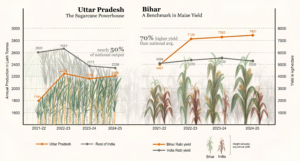 Gangetic Corridor – A Feedstock Frontier for Ethanol
(Illustration by Pritha Samanta; Based on 5-year APY data from MoAFW)
The Gangetic Advantage
Rice and sugarcane are well known to be water-intensive crops, while maize also carries a substantial water footprint. Given rice’s centrality to food security and its highest water footprint among the three, it is often regarded as the least sustainable feedstock for ethanol. This makes sugarcane and maize the primary candidates for EBP expansion.
Recent data from the Ministry of Agriculture and Farmers Welfare (MoAFW) suggest that states like Uttar Pradesh and Maharashtra are leading producers of sugarcane, while Bihar, Madhya Pradesh and Karnataka are major producers of maize. Collectively, the Gangetic states of UP and Bihar, with their fertile alluvial plains, relatively shallow aquifers and favourable thermal regime, constitute a large irrigated crop base. As compared to the water- stressed states of the Deccan plateau, they offer stronger natural endowments for feedstock expansion. On the other hand, Maharashtra and Karnataka have a dense sugar-industrial cooperative network, whereas UP and Bihar are widely regarded as having untapped agro-industrial potential.
High Production, Weak Systems
With annual production of around 2.23 billion litres, Uttar Pradesh has rapidly emerged as India’s largest ethanol producing state. In 2024-25, UP produced more sugarcane than Maharashtra and Karnataka combined. However, only around 43% of its cane reached the mills against 78% in Maharashtra, where a dense network of over 200 mills absorbs most of the crop. Limited mill absorption is further compounded by lower sugar recovery rates, with UP at 9.6% against 11.3% in Maharashtra. Thus, despite having a large cane base, value realization in Uttar Pradesh is constrained by a combination of factors.
The agrarian economy in UP is overwhelmingly dominated by small and marginal farmers. Mechanisation is often unaffordable, and heavy reliance on manual labour raises operational costs and further thins already modest margins. Much of the cane is still grown with traditional varieties, flood irrigation, and suboptimal nutrient management. Consequently, UP’s five-year average cane yield is around 81.2 tonnes per hectare, while Maharashtra reaches over 90 tonnes per hectare and Tamil Nadu over 100 tonnes per hectare. Depressed yields, together with lower sugar recovery rates, constrain the ethanol output per unit area despite Uttar Pradesh’s larger area under sugarcane cultivation.
Beyond the farm gate, inefficient procurement and transport systems stretch the time between harvest and processing, eroding sugar recovery and overall returns. Payment delays and uneven mill modernisation continue to restrict both farmer gains and sector efficiency. Finally, ethanol and sugar are only part of a deeper, more diverse sugarcane value chain. With downstream potential like cogeneration, bio-fertilizers, bio-plastics, etc., heavy investment in R&D and by‑product utilisation is needed to maximise value capture and lower the environmental footprint.
Unlike sugarcane, maize is not regulated in India. Its adaptable nature along with a short crop cycle (90-120 days) makes it a popular choice among farmers, particularly in climate- vulnerable regions like Bihar. The 11 ‘Maize Road’ districts in Northern Bihar produce about 13% of India’s maize, with yields nearly 70% higher than the national average. Bihar was the first state to introduce an Ethanol Production and Promotion Policy (2021), and 14 grain-based distilleries currently operate in the state while 47 more (grain and molasses based) are in the pipeline. Asia’s largest grain-based ethanol plant is being built in Jamui, with a capacity of 750 KLPD (kilo litres per day).
While the state expands its ethanol production, past studies have shown that over 80% of Bihar’s maize is shipped out for processing, depriving the local economy of value addition. Since the dismantling of formal marketing in 2014, maize supply chains in Bihar and eastern India have remained fragmented, with weak aggregation, inadequate storage, and limited organised market channels. Just like sugarcane, maize also anchors multiple value chains beyond ethanol. It is a major feed grain (especially for poultry) and a key input for food, pharmaceutical and cosmetic products. Thus, despite high yields, inadequate infrastructure constrains market access, deepens reliance on intermediaries, and weakens price discovery. The challenge, therefore, is not just increasing ethanol production, but retaining and diversifying maize value within the state.
Both feedstocks, sugarcane and maize, essentially mirror each other’s constraints. In UP, sugarcane shows lower per hectare production and poor sugar conversion, an outcome of weaker R&D, agronomy, and procurement networks—essentially the backward linkages. On the other hand, abundant maize in Bihar cannot find enough forward linkages in terms of storage, processing or market infrastructure. Collectively, these states have the skeleton of a dual-feed sugarcane–maize system but lack the muscle for strong agrarian, industrial and logistical linkages. This is precisely where India’s EBP program can reshape agrarian value chains in the region, by anchoring its backward and forward linkages to the crop base of sugarcane and maize.
Lessons from Brazil
Brazil offers a useful precedent, both for how an ethanol programme can be built over time and for the corrections that follow. The oil crisis of 1975 incentivized the Brazilian government to launch Proálcool, a sugarcane-based ethanol program that scaled investments in capacity, logistics, mechanisation and agronomic improvements. While public institutions developed cultivars suited to its conditions, private companies created the world’s largest germplasm bank. Between 2003 and 2009, Brazil’s ethanol production grew from 11.5 billion litres to about 28 billion litres. For context, NITI Aayog estimated that India will need about 10.16 billion litres to meet its E20 targets by 2025-26 .
But beyond advancements in technology and infrastructure, Proálcool was also framed to reduce income disparities, expand industries and create rural jobs. Municipalities with sugarcane plants showed better services and infrastructure, raising human development indicators, while several studies highlighted the millions of direct and indirect jobs in farming, transport and industry. Rapid expansion of ethanol production also brought high social and environmental costs, including deforestation, pollution and intensive agrochemical use. Under public pressure, the program was substantially adjusted to ensure that sugarcane production met minimum ‘sustainability’ criteria as an alternative energy source. Thus, by combining stable demand, local processing and infrastructure building, Brazil used ethanol to shape a broader rural development strategy, while continuing to focus on reducing its environmental impact.
From Feedstock Frontier to Rural Development
India’s rising ethanol consumption is both an opportunity and a potential distortion, especially in rural landscapes with marginal farms and thin safety nets. Without serious investments in R&D, mechanisation, storage and local processing, EBP risks extracting cane and maize from regions like UP and Bihar while leaving their rural environments worse off and economies unchanged. If more feedstock is to come from these regions, the real question is whether this demand is used to fix the agrarian distress and rural infrastructure or simply deepen their role as raw-material frontiers.
In Brazil, mechanisation transformed agriculture but contributed to land concentration and labour precarity. In UP and Bihar, marginal, and landless farmers form the backbone of the agrarian economy. Any mechanisation path must therefore be calibrated to serve them and not replicate Brazil’s exclusionary pattern. Rural development programs need to focus on co-producing infrastructures and institutions. Decentralised storage, processing and market infrastructure need to be supported by research, capacity building and agronomic support.
With climate change a constant factor, feedstock expansion must be anchored in better agronomy and water governance. Since ethanol feedstocks are largely water intensive, India must enforce stricter water conservation measures, develop drought-resistant varieties and realign feedstock production towards better endowed states like Bihar and UP. Ethanol is also closely linked to food security. Recent reports indicate that rising ethanol consumption is already putting upward pressure on prices of essential commodities like sugar and eggs. Ethanol expansion must therefore be calibrated to local agrarian conditions and crop availability while safeguarding crop diversity and food priorities.
Finally, ethanol must sit inside a wider agro-industrial strategy where efficiency gains in agriculture are complemented by multiple downstream avenues that generate value for the farmers. The viability of blended fuel will no doubt be debated, but if ethanol must come, it should be organised to serve agrarian clusters and create durable prosperity in rural India.
This article is produced under the Embark India Development Fellowship (EIDF).